Ch. 22 - Conjugated Systems 2: Pericyclic Reactions
Mullins - Organic Chemistry: A Learner Centered Approach 1st Edition
Mullins1st EditionOrganic Chemistry: A Learner Centered ApproachISBN: 9780137566471당신이 사용하는 게 아니라요?교과서 변경
21장, 문제 58

In Chapter 20, we studied the aldol reaction. Although not discussed at the time, this reaction is stereospecific, proceeding through the Zimmerman–Traxler transition state shown here.
(a) Show an arrow-pushing mechanism for this concerted reaction.
(b) Why is this a favorable mechanism?
Diagram illustrating the Zimmerman–Traxler transition state and arrow-pushing mechanism for a stereospecific reaction.

검증된 단계별 안내
1
Identify the reactants and the product in the aldol reaction. The reactants are a benzaldehyde and a lithium enolate, and the product is a β-hydroxy ketone.
Understand the Zimmerman–Traxler transition state, which is a six-membered chair-like transition state. This state is crucial for the stereospecificity of the reaction.
Draw the arrow-pushing mechanism: Start by showing the nucleophilic attack of the enolate carbon (C2) on the carbonyl carbon (C4) of the benzaldehyde. This forms a new C-C bond.
Simultaneously, show the movement of electrons from the carbonyl oxygen (O) to form a partial bond with lithium (Li), stabilizing the transition state.
Explain why this mechanism is favorable: The chair-like transition state minimizes steric hindrance and allows for the formation of a stable six-membered ring, which is energetically favorable. Additionally, the partial bonds help stabilize the transition state, making the reaction more efficient.

비슷한 문제에 대한 검증된 영상 답변:

이 영상 해법은 위 문제에 도움이 된다고 튜터들이 추천한 것입니다.
영상 길이:
7m
도움이 되었나요?

주요 개념

질문에 올바르게 답하기 위해 반드시 이해해야 하는 핵심 개념들은 다음과 같습니다.

Aldol Reaction

The aldol reaction is a fundamental carbon-carbon bond-forming reaction in organic chemistry, involving the nucleophilic addition of an enolate ion to a carbonyl compound. This reaction typically results in the formation of a β-hydroxy carbonyl compound, which can further undergo dehydration to yield an α,β-unsaturated carbonyl compound. Understanding the mechanism and stereochemistry of this reaction is crucial for predicting product formation.
추천 영상:
09:51
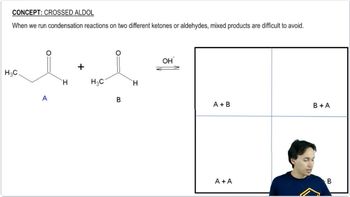
Crossed Aldol

Zimmerman–Traxler Transition State

The Zimmerman–Traxler transition state is a model used to explain the stereochemistry of certain aldol reactions. It describes a six-membered, chair-like transition state where the enolate and aldehyde are aligned in a specific orientation, leading to stereospecific outcomes. This model helps predict the stereochemical configuration of the aldol product based on the geometry of the transition state, emphasizing the importance of steric and electronic factors.
추천 영상:
06:55
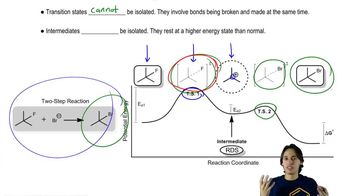
Intermediates vs. Transition States

Arrow-Pushing Mechanism

Arrow-pushing is a technique used to illustrate the movement of electrons during chemical reactions, particularly in organic chemistry. It involves using curved arrows to show the flow of electron pairs, helping to visualize how bonds are formed and broken. In the context of the aldol reaction, arrow-pushing is essential for understanding the step-by-step mechanism, including the formation of the enolate and its subsequent attack on the carbonyl group.
추천 영상:
04:32
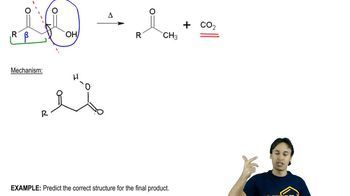
General Mechanism