Ch. 22 - Conjugated Systems 2: Pericyclic Reactions
Mullins - Organic Chemistry: A Learner Centered Approach 1st Edition
Mullins1st EditionOrganic Chemistry: A Learner Centered ApproachISBN: 9780137566471당신이 사용하는 게 아니라요?교과서 변경
21장, 문제 27b

Predict the product of the following [2 + 2] cycloadditions.
(b) Chemical structure diagram illustrating a [2 + 2] cycloaddition reaction yielding two possible products under light exposure.

검증된 단계별 안내
1
Identify the reactants: The given structure is a 1,5-hexadiene, which consists of two alkenes separated by a methylene group.
Understand the reaction type: A [2 + 2] cycloaddition involves the formation of a four-membered ring from two alkenes. Under photochemical conditions (hv), this reaction is allowed due to the involvement of excited states.
Consider the possible interactions: The two alkenes in 1,5-hexadiene can interact in two different ways to form cyclobutane rings. These interactions can occur between the terminal alkenes or between one terminal and the internal alkene.
Predict the first product: When the two terminal alkenes react, a cyclobutane ring is formed, resulting in a bicyclic structure with a bridgehead carbon.
Predict the second product: When one terminal alkene reacts with the internal alkene, a different cyclobutane ring is formed, leading to a different bicyclic structure. Both products are possible due to the symmetry and flexibility of the molecule.

비슷한 문제에 대한 검증된 영상 답변:

이 영상 해법은 위 문제에 도움이 된다고 튜터들이 추천한 것입니다.
도움이 되었나요?

주요 개념

질문에 올바르게 답하기 위해 반드시 이해해야 하는 핵심 개념들은 다음과 같습니다.

[2 + 2] Cycloaddition

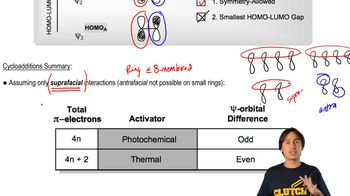
[2 + 2] Cycloaddition is a chemical reaction where two alkenes or alkynes form a four-membered ring. This reaction is typically photochemically induced, as thermal conditions often lead to different outcomes due to symmetry restrictions. The reaction involves the overlap of two π-bonds, resulting in the formation of two new σ-bonds, creating a cyclobutane ring.
추천 영상:
08:29
Cycloadditions Summary Chart

Photochemical Reactions

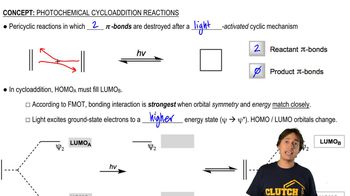
Photochemical reactions are chemical reactions initiated by the absorption of light, often ultraviolet or visible. In organic chemistry, light can provide the energy needed to overcome activation barriers, allowing reactions that are otherwise symmetry-forbidden under thermal conditions. The symbol 'hv' denotes the involvement of light, indicating that the reaction proceeds via an excited state.
추천 영상:
09:36
MO Theory of Photochemical Cycloadditions

Stereochemistry in Cycloadditions

Stereochemistry plays a crucial role in cycloaddition reactions, influencing the spatial arrangement of atoms in the resulting product. In [2 + 2] cycloadditions, the orientation of substituents on the reacting alkenes can lead to different stereoisomers. The reaction can yield both cis and trans isomers, depending on the relative orientation of the substituents in the starting materials and the reaction conditions.
추천 영상:
가이드 코스
1:38
Polymer Stereochemistry Concept 1