Ch. 23 - Benzene 1: Aromatic Stability and Substitution Reactions
Mullins - Organic Chemistry: A Learner Centered Approach 1st Edition
Mullins1st EditionOrganic Chemistry: A Learner Centered ApproachISBN: 9780137566471당신이 사용하는 게 아니라요?교과서 변경
22장, 문제 83

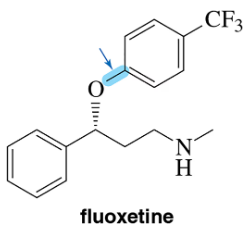
Fluoxetine, an antidepressant, is better known as Prozac®. Suggest reagents that could be used to make the indicated C–O bond of fluoxetine. [Note that CF3, an electron-withdrawing group, is para to where the new bond will be formed.]

검증된 단계별 안내
1
Identify the type of reaction needed to form the C–O bond in fluoxetine. This is typically an ether formation reaction.
Consider the electronic effects of the CF3 group, which is an electron-withdrawing group. This will influence the reactivity of the aromatic ring.
Select a suitable phenol or alcohol that can react with the aromatic ring to form the ether linkage. The presence of the CF3 group suggests that the reaction may require activation.
Choose a reagent that can facilitate the formation of the C–O bond. Common reagents for ether formation include strong bases or catalysts that can activate the alcohol or phenol.
Consider using a method such as the Williamson ether synthesis, which involves the deprotonation of an alcohol to form an alkoxide ion, followed by a nucleophilic substitution reaction with an aryl halide.

비슷한 문제에 대한 검증된 영상 답변:

이 영상 해법은 위 문제에 도움이 된다고 튜터들이 추천한 것입니다.

주요 개념

질문에 올바르게 답하기 위해 반드시 이해해야 하는 핵심 개념들은 다음과 같습니다.

Nucleophilic Aromatic Substitution

Nucleophilic aromatic substitution (NAS) is a reaction where a nucleophile replaces a leaving group on an aromatic ring. This process is facilitated by electron-withdrawing groups, such as CF3, which stabilize the negative charge in the intermediate. In fluoxetine, the CF3 group is para to the site of substitution, enhancing the reactivity of the aromatic ring towards nucleophiles.
추천 영상:
01:47
Nucleophiles and Electrophiles can react in Substitution Reactions.

Role of Electron-Withdrawing Groups

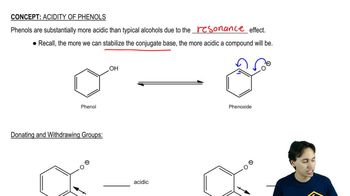
Electron-withdrawing groups (EWGs) like CF3 increase the electrophilicity of the aromatic ring by pulling electron density away from it. This makes the ring more susceptible to attack by nucleophiles. In the context of fluoxetine, the CF3 group enhances the likelihood of forming the C–O bond by stabilizing the transition state during the reaction.
추천 영상:
02:37
Donating vs Withdrawing Groups

Formation of Ether Bonds

The formation of ether bonds typically involves the reaction of an alcohol with an alkyl halide or through the Williamson ether synthesis. In the case of fluoxetine, the formation of the C–O bond can be achieved by using a suitable nucleophile, such as an alkoxide ion, which attacks the electrophilic carbon on the aromatic ring, facilitated by the presence of the CF3 group.
추천 영상:
가이드 코스
2:01
Disulfide Bonds Concept 1