Ch. 24 - Benzene 2: Reactions Influenced by the Aromatic Ring
Mullins - Organic Chemistry: A Learner Centered Approach 1st Edition
Mullins1st EditionOrganic Chemistry: A Learner Centered ApproachISBN: 9780137566471당신이 사용하는 게 아니라요?교과서 변경
23장, 문제 23

Assessment 24.22 asked why meta-dihydroxybenzene could not be oxidized to meta-quinone. The attempted oxidation instead gives rise to three different quinone products. Suggest a mechanism for the formation of each.
Chemical reaction showing meta-dihydroxybenzene oxidized by chromic acid, yielding three different quinone products.

검증된 단계별 안내
1
Identify the starting material as meta-dihydroxybenzene, also known as resorcinol, which has hydroxyl groups at the 1 and 3 positions on the benzene ring.
Recognize that the oxidizing agent used is chromic acid (H2CrO4), which is a strong oxidizing agent capable of converting phenols to quinones.
Understand that the oxidation of resorcinol does not lead to a single meta-quinone product due to the instability of such a structure. Instead, the reaction proceeds through different pathways leading to multiple products.
Propose a mechanism for the formation of the first product: The hydroxyl group at the 1-position is oxidized to a carbonyl group, forming a para-quinone structure with the remaining hydroxyl group at the 3-position.
Suggest mechanisms for the formation of the other two products: The hydroxyl group at the 3-position is oxidized to a carbonyl group, forming an ortho-quinone structure with the remaining hydroxyl group at the 1-position. Additionally, a rearrangement or further oxidation could lead to the formation of a third quinone structure with different positioning of the carbonyl groups.

비슷한 문제에 대한 검증된 영상 답변:

이 영상 해법은 위 문제에 도움이 된다고 튜터들이 추천한 것입니다.
영상 길이:
9m

주요 개념

질문에 올바르게 답하기 위해 반드시 이해해야 하는 핵심 개념들은 다음과 같습니다.

Dihydroxybenzene Structure

Dihydroxybenzene, also known as catechol, has two hydroxyl (-OH) groups attached to a benzene ring. The position of these groups significantly affects the compound's reactivity. In meta-dihydroxybenzene, the hydroxyl groups are located at the 1,3-positions, which influences the electron distribution and steric hindrance during oxidation reactions.
추천 영상:
03:04
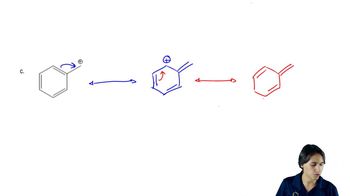
Drawing Resonance Structures

Oxidation Mechanism

Oxidation in organic chemistry typically involves the loss of electrons or an increase in oxidation state. In the case of meta-dihydroxybenzene, the oxidation process can lead to the formation of quinones, which are cyclic compounds with a conjugated double bond system. Understanding the specific pathways and intermediates formed during oxidation is crucial for predicting the products.
추천 영상:
01:31
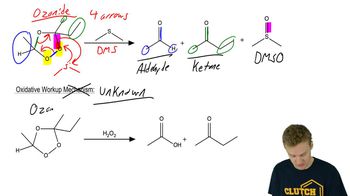
Oxidative Workup Mechanism:

Quinone Formation

Quinones are a class of cyclic organic compounds characterized by a six-membered ring with two carbonyl groups. The formation of different quinone products from meta-dihydroxybenzene can occur through various mechanisms, including rearrangements and the involvement of radical intermediates. Each pathway can yield distinct quinone structures based on the positions of the hydroxyl groups and the reaction conditions.
추천 영상:
가이드 코스
1:47
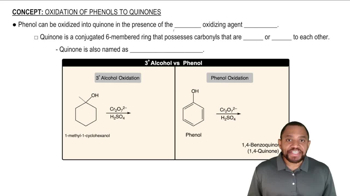
Oxidation of Phenols to Quinones Concept 1