Ch. 24 - Benzene 2: Reactions Influenced by the Aromatic Ring
Mullins - Organic Chemistry: A Learner Centered Approach 1st Edition
Mullins1st EditionOrganic Chemistry: A Learner Centered ApproachISBN: 9780137566471당신이 사용하는 게 아니라요?교과서 변경
23장, 문제 17

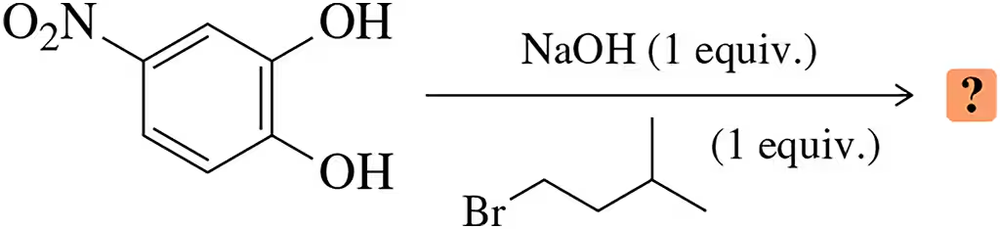
Predict the product when the dihydroxybenzene shown is treated with a single equivalent of both base and haloalkane.
Chemical structure of dihydroxybenzene with a reaction scheme showing sodium hydroxide and haloalkane, asking for the predicted product.

검증된 단계별 안내
1
Identify the functional groups in the dihydroxybenzene. The compound has two hydroxyl (OH) groups and a nitro (NO2) group attached to a benzene ring.
Recognize that the reaction involves a base (NaOH) and a haloalkane. The base will deprotonate one of the hydroxyl groups, forming a phenoxide ion.
Determine which hydroxyl group is more acidic. The presence of the electron-withdrawing nitro group increases the acidity of the hydroxyl group ortho to it, making it more likely to be deprotonated.
Consider the nucleophilic substitution reaction. The phenoxide ion, being a strong nucleophile, will attack the haloalkane, displacing the bromide ion and forming an ether linkage.
Predict the product structure. The reaction will result in the formation of an ether, where the alkyl group from the haloalkane is attached to the oxygen of the deprotonated hydroxyl group on the benzene ring.

비슷한 문제에 대한 검증된 영상 답변:

이 영상 해법은 위 문제에 도움이 된다고 튜터들이 추천한 것입니다.

주요 개념

질문에 올바르게 답하기 위해 반드시 이해해야 하는 핵심 개념들은 다음과 같습니다.

Dihydroxybenzene Reactivity

Dihydroxybenzenes, also known as catechols or resorcinols, contain two hydroxyl (-OH) groups on a benzene ring. The position of these groups affects the reactivity of the compound, particularly in nucleophilic substitution reactions. Understanding how these substituents influence electron density and steric hindrance is crucial for predicting the outcome of reactions with haloalkanes.
추천 영상:
01:17
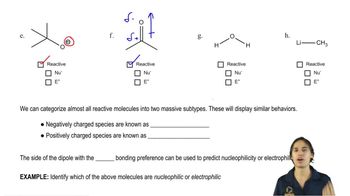
Reactivity of Molecules

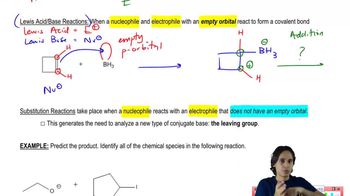
Nucleophilic Substitution Mechanism

Nucleophilic substitution is a fundamental reaction mechanism in organic chemistry where a nucleophile replaces a leaving group in a molecule. In the context of haloalkanes, the reaction can proceed via either an SN1 or SN2 pathway, depending on the structure of the haloalkane and the conditions. Recognizing which mechanism is favored helps in predicting the product formed when a dihydroxybenzene reacts with a haloalkane.
추천 영상:
01:47
Nucleophiles and Electrophiles can react in Substitution Reactions.

Base-Driven Deprotonation

When a dihydroxybenzene is treated with a base, one of the hydroxyl groups can be deprotonated, generating a phenoxide ion. This ion is a stronger nucleophile than the neutral dihydroxybenzene, enhancing its reactivity towards electrophiles like haloalkanes. Understanding the role of the base in facilitating this deprotonation is essential for predicting the product of the reaction.
추천 영상:
가이드 코스
1:23
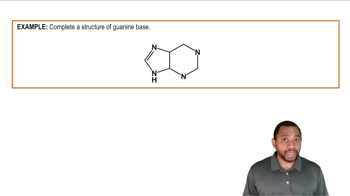
Nitrogenous Bases Example 3