Ch. 24 - Benzene 2: Reactions Influenced by the Aromatic Ring
Mullins - Organic Chemistry: A Learner Centered Approach 1st Edition
Mullins1st EditionOrganic Chemistry: A Learner Centered ApproachISBN: 9780137566471당신이 사용하는 게 아니라요?교과서 변경
23장, 문제 66

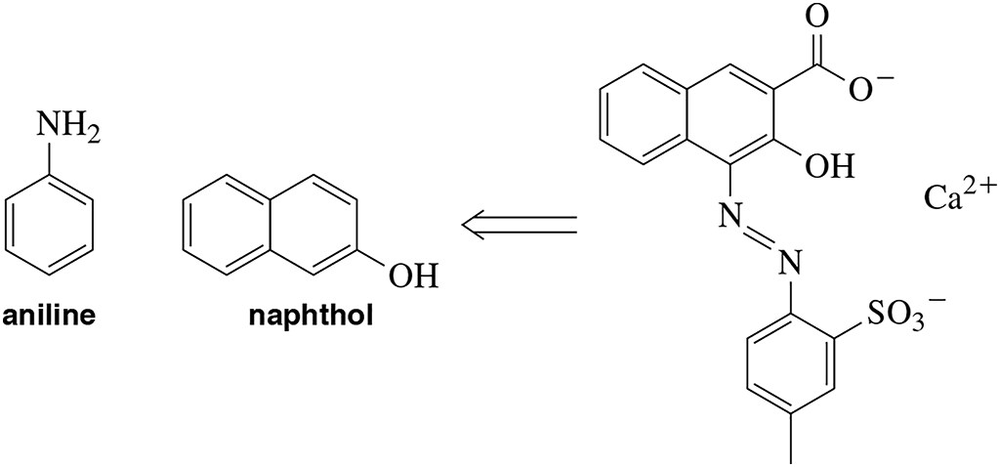
Synthesize the dye shown starting with aniline and naphthol using reactions from Chapters 23 and 24. [Hint. Start by identifying how each substituent might be installed and then plan the order of their introduction.]

검증된 단계별 안내
1
Identify the functional groups in the target dye molecule: a carboxylate group, a sulfonate group, and an azo linkage. The starting materials are aniline and naphthol.
Begin with the diazotization of aniline. Convert the amino group of aniline to a diazonium salt by treating it with nitrous acid (HNO2) in the presence of hydrochloric acid (HCl). This forms the diazonium ion, which is a key intermediate for azo coupling.
Perform azo coupling between the diazonium salt and naphthol. The naphthol acts as a nucleophile and attacks the diazonium ion, forming the azo linkage (N=N) between the two aromatic rings.
Introduce the sulfonate group by sulfonation of the aromatic ring. This can be achieved by treating the azo compound with sulfuric acid (H2SO4) to install the sulfonate group (SO3-) on the aromatic ring.
Finally, introduce the carboxylate group by carboxylation. This can be done by treating the naphthol moiety with carbon dioxide (CO2) under basic conditions to form the carboxylate group (COO-), which can then be neutralized with calcium ions (Ca2+) to form the calcium salt.

비슷한 문제에 대한 검증된 영상 답변:

이 영상 해법은 위 문제에 도움이 된다고 튜터들이 추천한 것입니다.

주요 개념

질문에 올바르게 답하기 위해 반드시 이해해야 하는 핵심 개념들은 다음과 같습니다.

Amino Group Reactivity

The amino group (-NH2) in aniline is a strong nucleophile, making it highly reactive in electrophilic aromatic substitution reactions. Understanding how to introduce substituents onto the aromatic ring of aniline is crucial, as the amino group can direct new substituents to ortho and para positions, influencing the overall structure of the final dye.
추천 영상:
09:36
Standard Amino Acids

Naphthol Chemistry

Naphthol, which contains a hydroxyl group (-OH) on a naphthalene ring, can participate in various reactions, including electrophilic substitutions and coupling reactions. The position of the hydroxyl group affects its reactivity and the types of reactions it can undergo, making it essential to consider when planning the synthesis of the dye.
추천 영상:
00:28
Introduction to General Chemistry Review

Dye Formation Mechanism

The synthesis of dyes often involves coupling reactions between aromatic amines and phenolic compounds. Understanding the mechanism of these reactions, including the formation of azo bonds and the role of catalysts or conditions, is vital for successfully synthesizing the desired dye structure from aniline and naphthol.
추천 영상:
02:26
Formation of Enolates