Ch. 24 - Benzene 2: Reactions Influenced by the Aromatic Ring
Mullins - Organic Chemistry: A Learner Centered Approach 1st Edition
Mullins1st EditionOrganic Chemistry: A Learner Centered ApproachISBN: 9780137566471당신이 사용하는 게 아니라요?교과서 변경
23장, 문제 29

Using Equation 5.8, calculate the difference in transition state energies that lead to the rate differences shown in Figure 24.35.
Chemical reaction diagrams comparing relative rates of two reactions, with values of 1 and 179 displayed prominently.

검증된 단계별 안내
1
Identify the two reactions shown in the image: one involves a simple alkyl chloride and the other involves a benzyl chloride. Both are reacting with NaI to form alkyl iodides.
Note the relative rates given in the image: the simple alkyl chloride reaction has a relative rate of 1, while the benzyl chloride reaction has a relative rate of 179.
Understand that the difference in relative rates is due to the difference in transition state energies. The benzyl chloride reaction is faster due to the stabilization of the transition state by the benzyl group.
Use Equation 5.8, which relates the rate constant to the activation energy: \( k = A e^{-E_a/RT} \). The difference in transition state energies can be calculated using the ratio of the rate constants.
Calculate the difference in transition state energies using the formula: \( \text{Difference in } E_a = -RT imes \text{ln}(\text{rate ratio}) \), where \( R \) is the gas constant and \( T \) is the temperature in Kelvin. Substitute the rate ratio (179/1) into the equation.

비슷한 문제에 대한 검증된 영상 답변:

이 영상 해법은 위 문제에 도움이 된다고 튜터들이 추천한 것입니다.
영상 길이:
4m
도움이 되었나요?

주요 개념

질문에 올바르게 답하기 위해 반드시 이해해야 하는 핵심 개념들은 다음과 같습니다.

Transition State Theory

Transition State Theory (TST) describes the formation of a transition state during a chemical reaction, which is a high-energy state that occurs between reactants and products. The energy of this state is crucial for understanding reaction rates, as it determines how easily reactants can convert into products. The difference in energy between the transition state and the reactants influences the activation energy required for the reaction to proceed.
추천 영상:
06:55
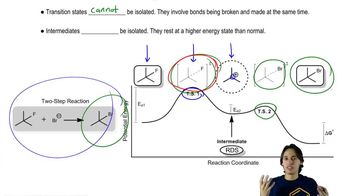
Intermediates vs. Transition States

Activation Energy

Activation energy is the minimum energy required for a chemical reaction to occur. It represents the energy barrier that must be overcome for reactants to reach the transition state. A higher activation energy typically results in a slower reaction rate, while a lower activation energy allows for faster reactions. Understanding activation energy is essential for analyzing the rate differences indicated in the question.
추천 영상:
08:30
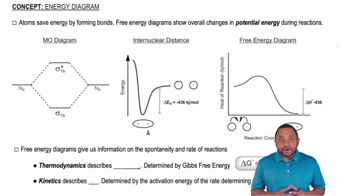
Introduction to free energy diagrams.

Rate Constants and Arrhenius Equation

The rate constant of a reaction is a proportionality factor that relates the reaction rate to the concentrations of reactants. The Arrhenius equation connects the rate constant to temperature and activation energy, showing that an increase in temperature or a decrease in activation energy leads to an increase in the rate constant. This relationship is fundamental for calculating and comparing the rate differences mentioned in the question.
추천 영상:
가이드 코스
2:29
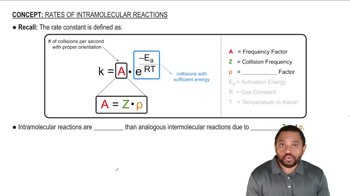
Rates of Intramolecular Reactions Concept 1