Ch. 25 - Amines: Structure, Reactions, and Synthesis
Mullins - Organic Chemistry: A Learner Centered Approach 1st Edition
Mullins1st EditionOrganic Chemistry: A Learner Centered ApproachISBN: 9780137566471당신이 사용하는 게 아니라요?교과서 변경
24장, 문제 55i

Predict the product(s) of the reactions shown.
(i)

검증된 단계별 안내
1
Step 1: Identify the starting material as phthalimide, which is a cyclic imide derived from phthalic acid.
Step 2: Recognize the first reagent, nBuBr (n-butyl bromide), which is an alkyl halide. This suggests an alkylation reaction where the nitrogen atom of the phthalimide will act as a nucleophile.
Step 3: Understand that the phthalimide nitrogen will attack the n-butyl bromide, displacing the bromide ion and forming N-butylphthalimide.
Step 4: Note the second step involves KOH and hydrazine (H2NNH2) under heat (Δ). This indicates a Gabriel synthesis, where the phthalimide is converted to a primary amine.
Step 5: In the Gabriel synthesis, hydrazine reacts with N-butylphthalimide to release the primary amine, n-butylamine, and form phthalhydrazide as a byproduct.

비슷한 문제에 대한 검증된 영상 답변:

이 영상 해법은 위 문제에 도움이 된다고 튜터들이 추천한 것입니다.
영상 길이:
2m

주요 개념

질문에 올바르게 답하기 위해 반드시 이해해야 하는 핵심 개념들은 다음과 같습니다.

Nucleophilic Substitution Reaction

Nucleophilic substitution is a fundamental class of reactions in organic chemistry where a nucleophile selectively bonds with or attacks the positive or partially positive charge of an atom or a group of atoms to replace a leaving group. In the given reaction, nBuBr (n-butyl bromide) acts as the alkylating agent, where the bromide ion is the leaving group, and the nitrogen atom in the imide acts as the nucleophile.
추천 영상:
01:47
Nucleophiles and Electrophiles can react in Substitution Reactions.

Gabriel Synthesis

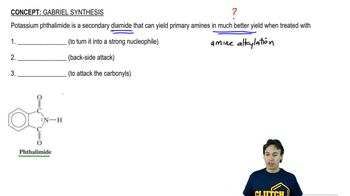
Gabriel synthesis is a method used to synthesize primary amines from primary alkyl halides. The reaction involves the use of phthalimide, which is deprotonated to form a nucleophilic phthalimide anion that reacts with an alkyl halide. In this reaction, the phthalimide is alkylated by nBuBr, and subsequent hydrazinolysis releases the primary amine, n-butylamine.
추천 영상:
04:53
General Reaction

Hydrazinolysis

Hydrazinolysis is a chemical reaction where hydrazine is used to cleave a bond, often in the context of removing protecting groups. In the Gabriel synthesis, hydrazinolysis is used to convert the N-alkylphthalimide intermediate into the corresponding primary amine. Here, hydrazine reacts with the alkylated phthalimide to release n-butylamine and phthalhydrazide as a byproduct.