Ch. 25 - Amines: Structure, Reactions, and Synthesis
Mullins - Organic Chemistry: A Learner Centered Approach 1st Edition
Mullins1st EditionOrganic Chemistry: A Learner Centered ApproachISBN: 9780137566471당신이 사용하는 게 아니라요?교과서 변경
24장, 문제 68

The synthesis of -hydroxy acids can be done starting with amino acids. Suggest a mechanism of the two-step transformation shown. [The alcohol oxygen is the same in the reactant and product.
Chemical reaction diagram illustrating the synthesis of α-hydroxy acids from amino acids, with highlighted reactants and products.

검증된 단계별 안내
1
Step 1: Begin by examining the starting material, which is an amino acid with a carboxylic acid group, an amino group, and an alcohol group. The target molecule is an ⍺-hydroxy acid with a cyano group replacing the amino group.
Step 2: The first step involves the use of NaNO₂ and HCl. This combination is typically used for diazotization, where the amino group is converted into a diazonium salt. The diazonium salt is a key intermediate that can undergo various transformations.
Step 3: In the second step, NaCN is introduced. The diazonium salt can be displaced by a nucleophile, such as cyanide ion (CN⁻), resulting in the formation of a nitrile group. This step involves a nucleophilic substitution reaction where the diazonium group is replaced by the cyano group.
Step 4: Throughout the reaction, the alcohol group remains unchanged. The mechanism ensures that the alcohol oxygen in the reactant is the same in the product, maintaining the integrity of the ⍺-hydroxy acid structure.
Step 5: Finally, verify the transformation by comparing the structures. The amino group has been successfully replaced by a cyano group, and the alcohol group remains intact, resulting in the desired ⍺-hydroxy acid.

비슷한 문제에 대한 검증된 영상 답변:

이 영상 해법은 위 문제에 도움이 된다고 튜터들이 추천한 것입니다.
영상 길이:
2m
도움이 되었나요?

주요 개념

질문에 올바르게 답하기 위해 반드시 이해해야 하는 핵심 개념들은 다음과 같습니다.

Amino Acid Structure and Reactivity

Amino acids are organic compounds that serve as the building blocks of proteins. They contain an amino group, a carboxyl group, and a side chain (R group) that determines their properties. Understanding the structure of amino acids is crucial for predicting their reactivity in chemical transformations, particularly in the synthesis of -hydroxy acids.
추천 영상:
7:19
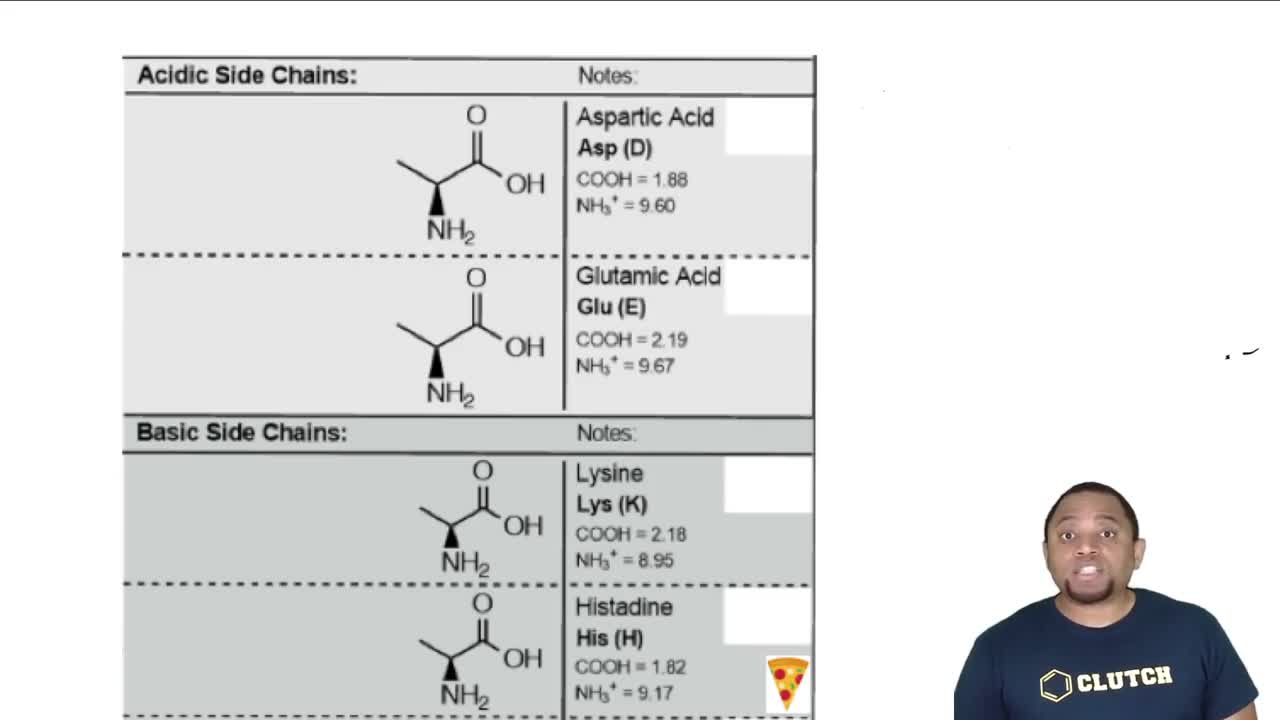
Charged Amino Acids

Mechanism of Organic Reactions

The mechanism of an organic reaction describes the step-by-step process by which reactants are converted into products. This includes the breaking and forming of bonds, the movement of electrons, and the intermediates formed during the reaction. A clear understanding of reaction mechanisms is essential for proposing a plausible pathway for the transformation of amino acids into -hydroxy acids.
추천 영상:
02:17
Identifying organic molecules

Functional Group Interconversion

Functional group interconversion involves the transformation of one functional group into another within a molecule. In the context of synthesizing -hydroxy acids from amino acids, recognizing how to convert amino groups and carboxyl groups into hydroxyl groups is vital. This concept is key to understanding how the final product retains the same alcohol oxygen as the starting material.
추천 영상:
02:36
Identifying Functional Groups