Ch. 25 - Amines: Structure, Reactions, and Synthesis
Mullins - Organic Chemistry: A Learner Centered Approach 1st Edition
Mullins1st EditionOrganic Chemistry: A Learner Centered ApproachISBN: 9780137566471당신이 사용하는 게 아니라요?교과서 변경
24장, 문제 15

We usually calculate Keq for acid–base reactions using pKa values.
(a) Derive an equation to calculate Keq using pKb values, then
(b) use it to calculate the equilibrium constant for the following reaction.
Chemical reaction diagram showing a base reacting with HCl, with pKb values labeled for each species.

검증된 단계별 안내
1
Step 1: Recall the relationship between pKa and pKb. The relationship is given by the equation: pKa + pKb = 14 (at 25°C). This equation connects the acid dissociation constant (Ka) and the base dissociation constant (Kb).
Step 2: Express the equilibrium constant (Keq) for an acid-base reaction in terms of Ka and Kb. For an acid-base reaction, Keq = KaacidKbbase. This equation shows that Keq is the ratio of the acid's Ka to the base's Kb.
Step 3: Convert the Ka and Kb values into their logarithmic forms using the pKa and pKb values. Recall that Ka = 10-pKa and Kb = 10-pKb. Substitute these into the Keq equation.
Step 4: Simplify the equation for Keq in terms of pKa and pKb. Using the properties of exponents, the equation becomes: Keq = 10(pKbbase - pKaacid). This is the derived equation to calculate Keq using pKb values.
Step 5: Apply the derived equation to the given reaction. Identify the pKa of the acid and the pKb of the base involved in the reaction. Substitute these values into the equation Keq = 10(pKbbase - pKaacid) to calculate the equilibrium constant.

비슷한 문제에 대한 검증된 영상 답변:

이 영상 해법은 위 문제에 도움이 된다고 튜터들이 추천한 것입니다.
영상 길이:
5m
도움이 되었나요?

주요 개념

질문에 올바르게 답하기 위해 반드시 이해해야 하는 핵심 개념들은 다음과 같습니다.

pKₐ and pKₑq Relationship

The pKₐ value is a measure of the strength of an acid in solution, defined as the negative logarithm of the acid dissociation constant (Kₐ). Similarly, pKₑq is the negative logarithm of the equilibrium constant (Kₑq) for a reaction. The relationship between pKₐ and pKₑq allows us to derive equations that connect these values, facilitating the calculation of equilibrium constants for acid-base reactions.
추천 영상:
가이드 코스
02:56
Isomeric Relationships

pKₑq Calculation from pKₐ and pKₑb

For acid-base reactions, the equilibrium constant can be calculated using the pKₐ of the acid and the pKₑb of the base involved. The equation Kₑq = 10^(pKₐ + pKₑb) allows us to derive Kₑq from the respective pK values. This relationship is crucial for understanding how the strengths of acids and bases influence the position of equilibrium in a reaction.
추천 영상:
가이드 코스
04:37
Draw all of the monochlorination products and calculate percentage yields.

Equilibrium Constant (Kₑq)

The equilibrium constant (Kₑq) quantifies the ratio of the concentrations of products to reactants at equilibrium for a given reaction. It provides insight into the extent to which a reaction proceeds and is influenced by temperature and the nature of the reactants and products. Understanding Kₑq is essential for predicting the behavior of acid-base reactions and their equilibria.
추천 영상:
가이드 코스
02:19
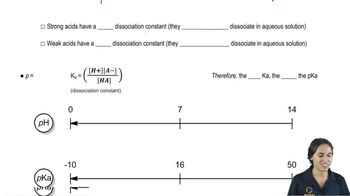
The relationship between equilibrium constant and pKa.