Ch. 25 - Amines: Structure, Reactions, and Synthesis
Mullins - Organic Chemistry: A Learner Centered Approach 1st Edition
Mullins1st EditionOrganic Chemistry: A Learner Centered ApproachISBN: 9780137566471당신이 사용하는 게 아니라요?교과서 변경
24장, 문제 3

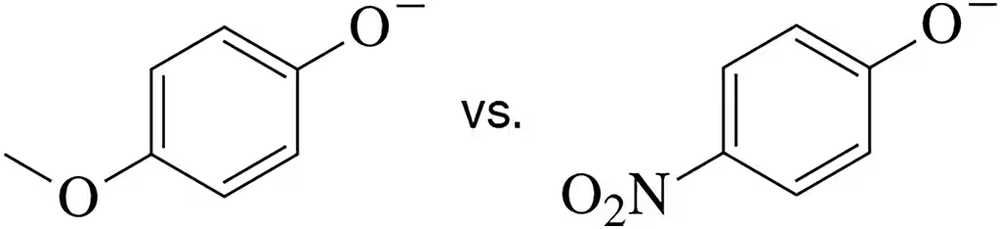
Which of the following phenoxides should be a stronger nucleophile?
Comparison of two phenoxide structures, one with a nitro group and one without, questioning nucleophilicity.

검증된 단계별 안내
1
Step 1: Understand the concept of nucleophilicity. Nucleophilicity refers to the ability of a species to donate a pair of electrons to an electrophile. It is influenced by factors such as charge, electronegativity, steric hindrance, and resonance effects.
Step 2: Analyze the structure of the phenoxides provided. Phenoxides are the conjugate bases of phenols, and their nucleophilicity is affected by the substituents on the aromatic ring. Electron-donating groups (EDGs) increase nucleophilicity, while electron-withdrawing groups (EWGs) decrease nucleophilicity.
Step 3: Identify the substituents on the phenoxide structures. Look for groups such as alkyl groups (EDGs) or nitro groups (EWGs) attached to the aromatic ring. EDGs stabilize the negative charge on the oxygen atom, making the phenoxide a stronger nucleophile.
Step 4: Consider the position of the substituents. Substituents in the ortho or para positions relative to the oxygen atom can have a stronger resonance or inductive effect compared to those in the meta position. This can further influence nucleophilicity.
Step 5: Compare the phenoxides based on the substituents and their positions. The phenoxide with the most electron-donating substituents in favorable positions (ortho or para) will be the stronger nucleophile.

비슷한 문제에 대한 검증된 영상 답변:

이 영상 해법은 위 문제에 도움이 된다고 튜터들이 추천한 것입니다.
영상 길이:
4m

주요 개념

질문에 올바르게 답하기 위해 반드시 이해해야 하는 핵심 개념들은 다음과 같습니다.

Nucleophilicity

Nucleophilicity refers to the ability of a species to donate an electron pair to an electrophile during a chemical reaction. Strong nucleophiles are typically negatively charged or have lone pairs of electrons that can be readily shared. Factors influencing nucleophilicity include charge, electronegativity, and solvent effects, with stronger nucleophiles being more reactive in nucleophilic substitution reactions.
추천 영상:
08:27
Nucleophilic Addition

Phenoxide Ion Stability

Phenoxide ions are formed when phenols lose a proton from their hydroxyl group, resulting in a negatively charged oxygen atom. The stability of the phenoxide ion is crucial for its nucleophilicity; resonance stabilization allows the negative charge to be delocalized over the aromatic ring, enhancing its reactivity. The more stable the phenoxide ion, the stronger the nucleophile it can be, as it can better stabilize the negative charge.
추천 영상:
가이드 코스
3:39
Metal Ion Catalysis Concept 1

Resonance Effects

Resonance effects occur when electrons are delocalized across adjacent atoms, particularly in conjugated systems like aromatic rings. In phenoxides, resonance allows the negative charge on the oxygen to be shared with the aromatic system, which can enhance nucleophilicity. The presence of electron-donating groups can further increase nucleophilicity by stabilizing the negative charge, while electron-withdrawing groups can decrease it.
추천 영상:
03:32
Understanding Resonance Effects