
Ch. 3 - Alkanes and Cycloalkanes: Properties and Conformational Analysis
Mullins - Organic Chemistry: A Learner Centered Approach 1st Edition
Mullins1st EditionOrganic Chemistry: A Learner Centered ApproachISBN: 9780137566471당신이 사용하는 게 아니라요?교과서 변경
2장, 문제 23a

Calculate the dihedral angle (θ) for the conformations shown.
(a) Newman projection diagram showing a molecule with labeled atoms and a dihedral angle (θ) indicated by an arrow.

검증된 단계별 안내
1
Identify the conformation shown in the problem. Determine whether it is a staggered, eclipsed, or gauche conformation by analyzing the spatial arrangement of the substituents around the bond in question.
Locate the two atoms or groups of interest on the Newman projection or molecular diagram. These groups will help define the dihedral angle (θ).
Define the dihedral angle (θ) as the angle between the planes formed by the front carbon and its substituents, and the back carbon and its substituents. For a staggered conformation, θ is typically 60°, 120°, or 180°, while for an eclipsed conformation, θ is 0° or 120°.
Use the Newman projection to measure the angle between the substituents on the front and back carbons. This can be done by visualizing the rotation of the back carbon relative to the front carbon.
Assign the correct dihedral angle (θ) based on the relative positions of the substituents. For example, if the substituents are directly opposite each other, θ = 180° (anti conformation). If they are adjacent, θ = 60° (gauche conformation).

비슷한 문제에 대한 검증된 영상 답변:

이 영상 해법은 위 문제에 도움이 된다고 튜터들이 추천한 것입니다.
영상 길이:
3m
도움이 되었나요?

주요 개념

질문에 올바르게 답하기 위해 반드시 이해해야 하는 핵심 개념들은 다음과 같습니다.

Dihedral Angle

A dihedral angle is the angle between two intersecting planes, specifically the angle formed by two sets of three atoms in a molecule. It is crucial in understanding the spatial arrangement of atoms and how they influence molecular conformation. In organic chemistry, dihedral angles help predict the stability and reactivity of different conformations of a molecule.
추천 영상:
02:46
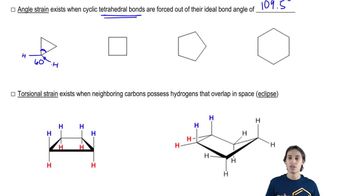
What is angle strain?

Conformational Analysis

Conformational analysis is the study of the different spatial arrangements of atoms in a molecule that can be interconverted by rotation around single bonds. This analysis is essential for understanding how molecular shape affects properties such as reactivity and interaction with other molecules. It often involves visualizing and calculating angles, including dihedral angles, to assess the stability of various conformers.
추천 영상:
03:29
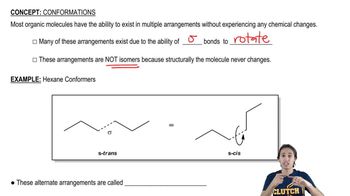
Understanding what a conformer is.

Staggered vs. Eclipsed Conformations

In conformational analysis, staggered and eclipsed conformations refer to the relative positions of atoms or groups around a bond. Staggered conformations, where groups are positioned 60 degrees apart, are generally more stable due to minimized steric hindrance. In contrast, eclipsed conformations, where groups are aligned, experience increased repulsion and are less stable, making the understanding of these conformations vital for calculating dihedral angles.
추천 영상:
03:29
Understanding what a conformer is.