Ch. 3 - Alkanes and Cycloalkanes: Properties and Conformational Analysis
Mullins - Organic Chemistry: A Learner Centered Approach 1st Edition
Mullins1st EditionOrganic Chemistry: A Learner Centered ApproachISBN: 9780137566471당신이 사용하는 게 아니라요?교과서 변경
2장, 문제 26b

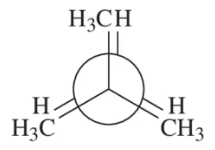
Calculate the total strain in the eclipsed conformations shown.
(b) Structural diagram of a cycloalkane with labeled hydrogen atoms, illustrating eclipsed conformations for strain calculation.

검증된 단계별 안내
1
Step 1: Identify the type of strain present in the eclipsed conformation. In this case, the strain arises from torsional strain (due to eclipsing interactions) and steric strain (due to bulky groups being in close proximity).
Step 2: Analyze the interactions between the groups in the eclipsed conformation. For example, the CH₃ groups and H atoms are eclipsing each other, leading to torsional strain. Additionally, the CH₃ groups are bulky and contribute to steric strain.
Step 3: Assign energy values to each type of interaction. Typically, the torsional strain for CH₃-H eclipsing interactions is around 1.0 kcal/mol, and for CH₃-CH₃ eclipsing interactions, it is around 3.0 kcal/mol. These values are standard and can be used for estimation.
Step 4: Count the number of each type of interaction in the eclipsed conformation. For example, there may be two CH₃-H eclipsing interactions and one CH₃-CH₃ eclipsing interaction.
Step 5: Sum the energy contributions from all interactions to calculate the total strain. Multiply the number of interactions by their respective energy values and add them together to find the total strain in the eclipsed conformation.

비슷한 문제에 대한 검증된 영상 답변:

이 영상 해법은 위 문제에 도움이 된다고 튜터들이 추천한 것입니다.

주요 개념

질문에 올바르게 답하기 위해 반드시 이해해야 하는 핵심 개념들은 다음과 같습니다.

Conformational Strain

Conformational strain refers to the energy increase associated with the spatial arrangement of atoms in a molecule. In eclipsed conformations, atoms or groups are aligned with each other, leading to increased steric hindrance and torsional strain. Understanding this concept is crucial for calculating the total strain in different conformations.
추천 영상:
02:00
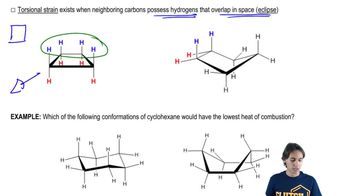
What is torsional strain?

Eclipsed vs. Staggered Conformations

Eclipsed conformations occur when atoms or groups are directly aligned with each other, resulting in higher energy states due to increased repulsion. In contrast, staggered conformations have groups positioned at angles to each other, minimizing strain. Recognizing the differences between these conformations is essential for analyzing strain in molecular structures.
추천 영상:
03:29
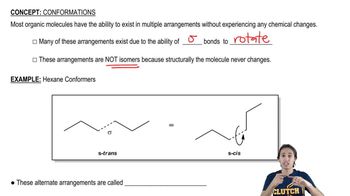
Understanding what a conformer is.

Torsional Strain

Torsional strain arises from the eclipsing interactions between adjacent bonds in a molecule. It is a specific type of conformational strain that occurs when bonds are rotated into an eclipsed position, leading to increased energy. This concept is vital for quantifying the total strain in eclipsed conformations, as it directly impacts molecular stability.
추천 영상:
02:00
What is torsional strain?