Ch. 3 - Alkanes and Cycloalkanes: Properties and Conformational Analysis
Mullins - Organic Chemistry: A Learner Centered Approach 1st Edition
Mullins1st EditionOrganic Chemistry: A Learner Centered ApproachISBN: 9780137566471당신이 사용하는 게 아니라요?교과서 변경
2장, 문제 17b

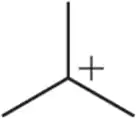
When we begin studying reactive intermediates, the designation of substitution will be especially important. Label the following carbocations as 1° , 2°, 3°, or 4° or based on the carbon bearing the positive charge.
(b) Skeletal structure of a carbocation with a positive charge on a carbon atom, indicating its classification.

검증된 단계별 안내
1
Step 1: Understand the concept of carbocation substitution. The degree of substitution (1°, 2°, 3°, or 4°) refers to the number of carbon atoms directly attached to the carbon bearing the positive charge. A 1° carbocation has one carbon attached, a 2° carbocation has two carbons attached, and so on.
Step 2: Examine the structure of the carbocation provided in part (b). Identify the carbon atom that bears the positive charge.
Step 3: Count the number of carbon atoms directly bonded to the positively charged carbon. These are the substituents that determine the degree of substitution.
Step 4: Based on the count, assign the appropriate designation: 1° (primary), 2° (secondary), 3° (tertiary), or 4° (quaternary). For example, if the positively charged carbon is bonded to three other carbons, it is a 3° carbocation.
Step 5: Verify your answer by ensuring that you have correctly identified the substituents and their direct attachment to the positively charged carbon. Double-check the structure for accuracy.

비슷한 문제에 대한 검증된 영상 답변:

이 영상 해법은 위 문제에 도움이 된다고 튜터들이 추천한 것입니다.
영상 길이:
1m

주요 개념

질문에 올바르게 답하기 위해 반드시 이해해야 하는 핵심 개념들은 다음과 같습니다.

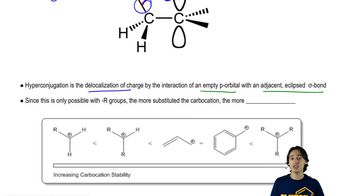
Carbocation Stability

Carbocations are positively charged carbon species that are classified based on the number of alkyl groups attached to the carbon bearing the positive charge. The stability of carbocations increases with the degree of substitution: tertiary (3°) carbocations are more stable than secondary (2°), which are more stable than primary (1°). This stability is due to hyperconjugation and the inductive effect of alkyl groups, which help to disperse the positive charge.
추천 영상:
05:58
Determining Carbocation Stability

Degree of Substitution

The degree of substitution refers to the number of carbon atoms directly attached to the carbon atom that carries the positive charge in a carbocation. A carbon atom can be classified as primary (1°) if it is attached to one other carbon, secondary (2°) if attached to two, tertiary (3°) if attached to three, and quaternary (4°) if attached to four. This classification is crucial for predicting the reactivity and stability of carbocations in organic reactions.
추천 영상:
01:47
Nucleophiles and Electrophiles can react in Substitution Reactions.

Reactivity of Carbocations

Carbocations are highly reactive intermediates in organic chemistry, often formed during reactions such as electrophilic addition or rearrangements. Their reactivity is influenced by their stability; more stable carbocations are less likely to undergo rearrangement and more likely to participate in subsequent reactions. Understanding the reactivity patterns of different carbocation types is essential for predicting the outcomes of organic reactions.
추천 영상:
07:21
Any Carbocation