Ch. 4 - Acids and Bases/Electron Flow
Mullins - Organic Chemistry: A Learner Centered Approach 1st Edition
Mullins1st EditionOrganic Chemistry: A Learner Centered ApproachISBN: 9780137566471당신이 사용하는 게 아니라요?교과서 변경
3장, 문제 32

How do you know that a proton with a low pKa value is acidic (besides 'I just remember')?

검증된 단계별 안내
1
Understand the concept of pKₐ: The pKₐ value is a measure of the strength of an acid. It is the negative logarithm of the acid dissociation constant (Kₐ), which quantifies how easily a proton (H⁺) is released from an acid molecule. Mathematically, pKₐ = -log(Kₐ). Lower pKₐ values correspond to stronger acids because they dissociate more readily in solution.
Relate pKₐ to proton acidity: A proton associated with a molecule is considered acidic if it can be easily donated to a base. Molecules with low pKₐ values have protons that are more likely to dissociate, making them more acidic. This is because a low pKₐ indicates a high Kₐ, meaning the equilibrium strongly favors the dissociated form (H⁺ and the conjugate base).
Examine molecular structure and stability: Acidity is influenced by the stability of the conjugate base formed after the proton is donated. If the conjugate base is stabilized (e.g., through resonance, inductive effects, or electronegativity), the proton is more likely to dissociate, resulting in a lower pKₐ value. For example, carboxylic acids have low pKₐ values because their conjugate bases are resonance-stabilized.
Consider solvent effects: The solvent can also affect the acidity of a proton. In polar solvents, acidic protons are more likely to dissociate because the solvent stabilizes the ions formed during dissociation. This contributes to the observed low pKₐ values for strong acids in aqueous solutions.
Apply this knowledge to predict acidity: When analyzing a molecule, look for factors such as electronegativity of the atom bonded to the proton, resonance stabilization of the conjugate base, and inductive effects from nearby electronegative groups. These factors collectively explain why a proton with a low pKₐ value is acidic, beyond simply memorizing the value.

비슷한 문제에 대한 검증된 영상 답변:

이 영상 해법은 위 문제에 도움이 된다고 튜터들이 추천한 것입니다.
도움이 되었나요?

주요 개념

질문에 올바르게 답하기 위해 반드시 이해해야 하는 핵심 개념들은 다음과 같습니다.

pKₐ and Acidity

The pKₐ value is a quantitative measure of the strength of an acid in solution. It is the negative logarithm of the acid dissociation constant (Kₐ), which indicates how readily an acid donates protons (H⁺) to the solution. A lower pKₐ value signifies a stronger acid, meaning it dissociates more completely in water, thus increasing the concentration of protons and making the solution more acidic.
추천 영상:
02:23
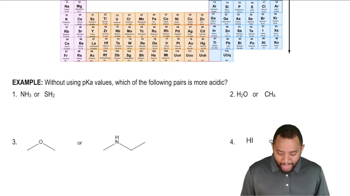
Using factors affecting acidity to rank acids

Acid-Base Equilibrium

Acid-base equilibrium refers to the balance between the concentrations of acids and their conjugate bases in a solution. When an acid donates a proton, it forms its conjugate base. The position of this equilibrium is influenced by the strength of the acid, which is reflected in its pKₐ value. Understanding this equilibrium helps predict how changes in concentration or pH affect the acidity of a solution.
추천 영상:
04:00
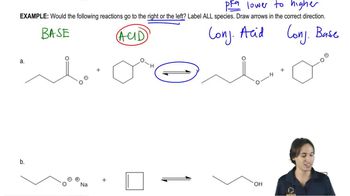
Determining Acid/Base Equilibrium

Factors Affecting Acidity

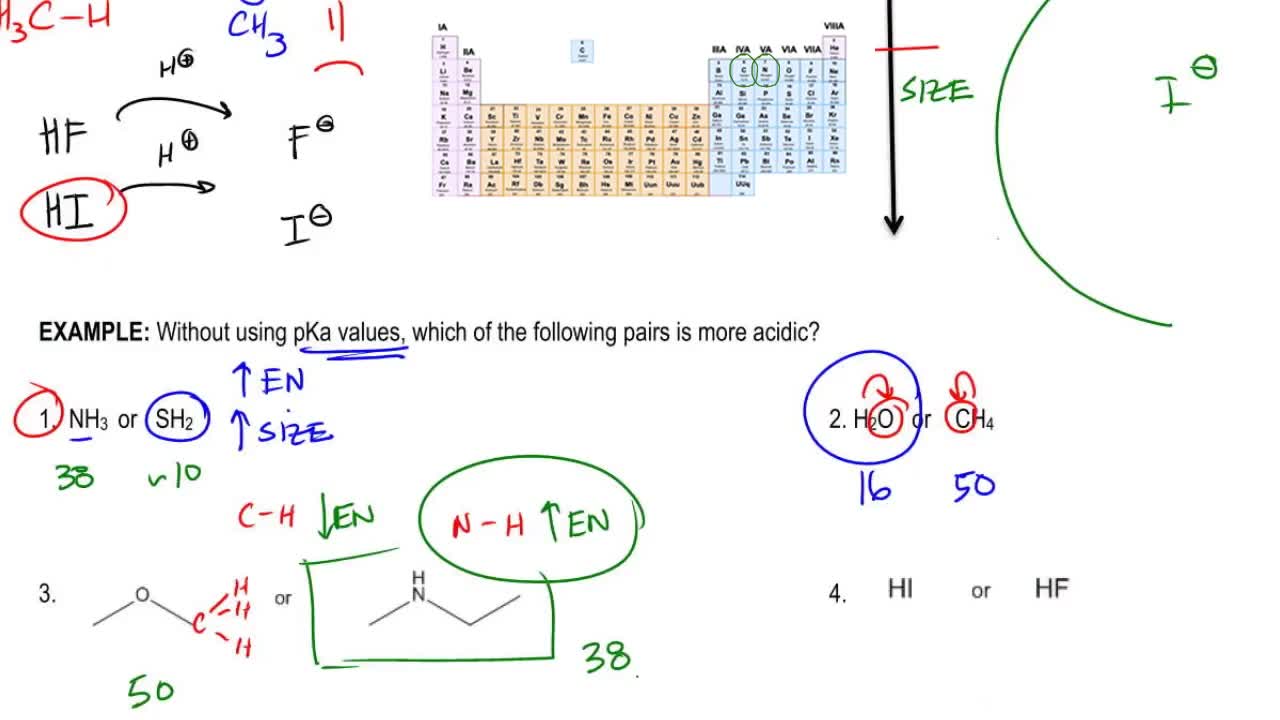
Several factors influence the acidity of a compound, including electronegativity, atomic size, and resonance stabilization. For instance, if the conjugate base of an acid is stabilized by resonance, the acid will be stronger and have a lower pKₐ. Additionally, the presence of electronegative atoms can pull electron density away from the bond to the proton, making it easier for the acid to donate the proton and thus increasing its acidity.
추천 영상:
00:57
Using factors affecting acidity to rank acids