Ch. 4 - Acids and Bases/Electron Flow
Mullins - Organic Chemistry: A Learner Centered Approach 1st Edition
Mullins1st EditionOrganic Chemistry: A Learner Centered ApproachISBN: 9780137566471당신이 사용하는 게 아니라요?교과서 변경
3장, 문제 12c

Identify the base from which the following conjugate acids were formed. [The most acidic proton is indicated.]
(c) Diagram showing a molecule with a highlighted acidic proton and a question mark indicating the base for the conjugate acid.

검증된 단계별 안내
1
Identify the conjugate acid provided in the problem. A conjugate acid is formed when a base gains a proton (H⁺). Look for the structure of the conjugate acid and locate the proton that is indicated as the most acidic.
Remove the most acidic proton (H⁺) from the conjugate acid. This step involves deprotonation, which is the reverse of protonation. The removal of this proton will yield the base from which the conjugate acid was formed.
Analyze the resulting structure after deprotonation. Ensure that the charge and bonding are correctly adjusted. For example, if the proton was removed from an oxygen atom, the oxygen will now carry a negative charge (O⁻).
Determine the identity of the base. The base is the species that remains after the conjugate acid loses its proton. Compare the structure to known functional groups or molecules to name the base.
Verify your answer by considering the acid-base relationship. The conjugate acid-base pair should differ by exactly one proton. Ensure that the base you identified can accept a proton to regenerate the original conjugate acid.

비슷한 문제에 대한 검증된 영상 답변:

이 영상 해법은 위 문제에 도움이 된다고 튜터들이 추천한 것입니다.
영상 길이:
1m
도움이 되었나요?

주요 개념

질문에 올바르게 답하기 위해 반드시 이해해야 하는 핵심 개념들은 다음과 같습니다.

Conjugate Acids and Bases

In acid-base chemistry, a conjugate acid is formed when a base accepts a proton (H+), while a conjugate base is what remains after an acid donates a proton. Understanding this relationship is crucial for identifying the base from which a conjugate acid is derived, as it directly relates to the proton transfer process.
추천 영상:
02:11
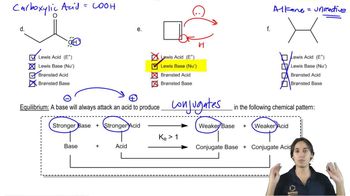
Equilibrium constant and conjugates.

Acidity and pKa

Acidity is a measure of how readily a substance donates protons in solution, often quantified by the pKa value. The lower the pKa, the stronger the acid, indicating a greater tendency to lose a proton. Recognizing the most acidic proton in a molecule helps in determining the corresponding base, as it highlights the site of proton donation.
추천 영상:
07:45
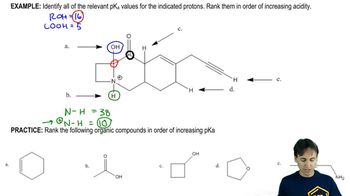
Identifying pKa values

Proton Transfer Mechanism

The proton transfer mechanism is a fundamental process in organic chemistry where protons are transferred between molecules, influencing their reactivity and stability. This mechanism is essential for understanding how conjugate acids and bases interconvert, allowing for the identification of the base from which a given conjugate acid is formed.
추천 영상:
가이드 코스
3:05
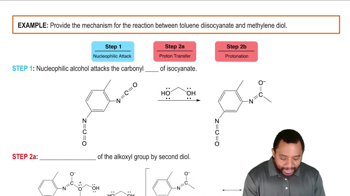
Polyurethane Mechanism Example 1