Ch. 4 - Acids and Bases/Electron Flow
Mullins - Organic Chemistry: A Learner Centered Approach 1st Edition
Mullins1st EditionOrganic Chemistry: A Learner Centered ApproachISBN: 9780137566471당신이 사용하는 게 아니라요?교과서 변경
3장, 문제 63c

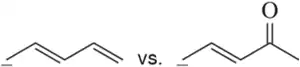
Identify the stronger base in each pair. Explain your choice. Citing pKa values is not an acceptable answer.
(c) Chemical structures comparing two compounds, highlighting their differences in acidity and basicity.

검증된 단계별 안내
1
Step 1: Understand the concept of basicity. A base is a substance that can accept a proton (H⁺). The strength of a base depends on its ability to stabilize the negative charge after accepting a proton. Factors such as electronegativity, resonance, and steric hindrance play a role in determining basicity.
Step 2: Analyze the molecular structure of each compound in the pair. Look for features such as the presence of electronegative atoms, resonance stabilization, or bulky groups that might affect the ability of the molecule to accept and stabilize a proton.
Step 3: Consider the role of resonance. If one of the bases has resonance structures that can delocalize the negative charge after accepting a proton, it will generally be a weaker base because the negative charge is more stabilized.
Step 4: Evaluate the electronegativity of the atoms involved. A base with a less electronegative atom holding the negative charge will generally be stronger because it is less able to stabilize the charge, making it more reactive.
Step 5: Assess steric hindrance. If one of the bases has bulky groups near the site where it would accept a proton, this can make it less accessible to the proton and therefore a weaker base.

비슷한 문제에 대한 검증된 영상 답변:

이 영상 해법은 위 문제에 도움이 된다고 튜터들이 추천한 것입니다.
영상 길이:
3m
도움이 되었나요?

주요 개념

질문에 올바르게 답하기 위해 반드시 이해해야 하는 핵심 개념들은 다음과 같습니다.

Acidity and Basicity

Acidity refers to the tendency of a compound to donate protons (H⁺ ions), while basicity is the tendency to accept protons. The strength of a base is often related to its ability to stabilize the positive charge that results from protonation. Understanding the relationship between acids and bases is crucial for determining which compound in a pair is the stronger base.
추천 영상:
06:21
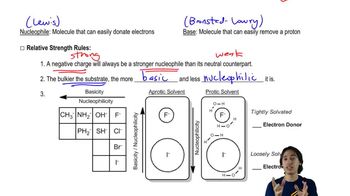
Understanding the difference between basicity and nucleophilicity.

Resonance Stabilization

Resonance stabilization occurs when a molecule can be represented by multiple valid Lewis structures, allowing for the delocalization of electrons. A base that can stabilize its negative charge through resonance is generally stronger because it can distribute the charge over a larger area, making it less likely to re-protonate. This concept is essential for comparing the basicity of different compounds.
추천 영상:
03:43
The radical stability trend.

Electronegativity

Electronegativity is the tendency of an atom to attract electrons towards itself. In the context of basicity, a less electronegative atom is more likely to donate its electrons, making it a stronger base. Understanding the electronegativity of atoms within the compounds being compared helps in predicting which will be the stronger base in a given pair.
추천 영상:
1:47
Electronegativity