Ch. 4 - Acids and Bases/Electron Flow
Mullins - Organic Chemistry: A Learner Centered Approach 1st Edition
Mullins1st EditionOrganic Chemistry: A Learner Centered ApproachISBN: 9780137566471당신이 사용하는 게 아니라요?교과서 변경
3장, 문제 20c(i,ii,iii)

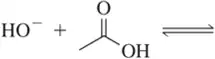
In the following reactions,
(i) identify the acid and base,
(ii) identify the most electron-rich atom in the base,
(iii) identify the most acidic hydrogen in the acid,
(c) Chemical reaction showing hydroxide ion reacting with a carbonyl compound, illustrating acid-base interactions.

검증된 단계별 안내
1
Step 1: Identify the acid and base in the reaction. Ethanolate (CH3CH2O⁻) is the base because it has a negative charge and can donate electrons. Acetic acid (CH3COOH) is the acid because it has a proton (H⁺) attached to the oxygen that can be donated.
Step 2: Determine the most electron-rich atom in the base. In ethanolate, the oxygen atom is the most electron-rich because it carries a negative charge and has lone pairs of electrons.
Step 3: Identify the most acidic hydrogen in the acid. In acetic acid, the hydrogen attached to the hydroxyl group (-OH) is the most acidic because it is bonded to an electronegative oxygen atom, which stabilizes the negative charge after deprotonation.
Step 4: Analyze the reaction mechanism. The base (ethanolate) will attack the acidic hydrogen of acetic acid, leading to the formation of ethanol (CH3CH2OH) and acetate ion (CH3COO⁻).
Step 5: Consider the equilibrium. The reaction is reversible, and the position of equilibrium depends on the relative acidity of acetic acid and ethanol, as well as the stability of the conjugate base (acetate ion) and conjugate acid (ethanol).

비슷한 문제에 대한 검증된 영상 답변:

이 영상 해법은 위 문제에 도움이 된다고 튜터들이 추천한 것입니다.
영상 길이:
5m

주요 개념

질문에 올바르게 답하기 위해 반드시 이해해야 하는 핵심 개념들은 다음과 같습니다.

Acids and Bases

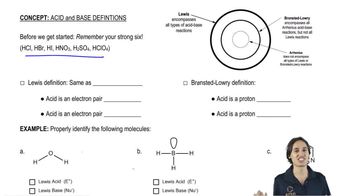
In organic chemistry, acids are substances that can donate a proton (H+), while bases are substances that can accept a proton. The Brønsted-Lowry theory defines acids and bases based on their ability to transfer protons. In the given reaction, acetic acid acts as the acid, and ethanolate serves as the base.
추천 영상:
02:49
The Lewis definition of acids and bases.

Electron-Rich Atoms

The most electron-rich atom in a base is typically the atom that has a lone pair of electrons available for bonding. In the case of ethanolate, the oxygen atom carries a negative charge and has a lone pair, making it the most electron-rich atom. This property is crucial for its ability to act as a base in the reaction.
추천 영상:
01:44
The difference between atomic numbers and atomic mass.

Acidic Hydrogens

The most acidic hydrogen in an acid is the hydrogen atom that is most easily released as a proton. In acetic acid, the hydrogen attached to the hydroxyl group (-OH) is the most acidic due to the stability of the resulting acetate ion after deprotonation. Identifying this hydrogen is essential for understanding the acid's reactivity.
추천 영상:
00:48
The definition of hydrogenation.