Ch. 4 - Acids and Bases/Electron Flow
Mullins - Organic Chemistry: A Learner Centered Approach 1st Edition
Mullins1st EditionOrganic Chemistry: A Learner Centered ApproachISBN: 9780137566471당신이 사용하는 게 아니라요?교과서 변경
3장, 문제 58a

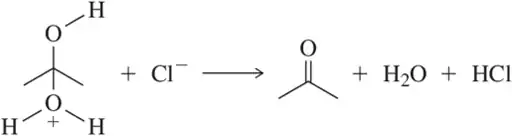
Show an arrow-pushing mechanism that forms the product on the right from the reactant at left. Here, three arrows are necessary in each reaction.
(a) Arrow-pushing mechanism illustrating the reaction of a reactant forming products with three arrows indicating electron movement.

검증된 단계별 안내
1
Step 1: Identify the functional groups and reactive sites in the reactant molecule. Look for nucleophilic and electrophilic centers that will participate in the reaction.
Step 2: Determine the type of reaction mechanism involved (e.g., substitution, elimination, addition). Based on the problem, focus on the arrow-pushing mechanism to show electron movement.
Step 3: Draw the first curved arrow to represent the movement of electrons from the nucleophile (electron donor) to the electrophile (electron acceptor). Ensure the arrow starts from a lone pair or bond and points toward the electrophilic center.
Step 4: Draw the second curved arrow to show the breaking of a bond as electrons are redistributed. This typically occurs when a leaving group departs or a bond rearranges.
Step 5: Draw the third curved arrow to complete the formation of the product. This may involve the formation of a new bond or stabilization of charges. Ensure all charges and lone pairs are correctly accounted for in the final structure.

비슷한 문제에 대한 검증된 영상 답변:

이 영상 해법은 위 문제에 도움이 된다고 튜터들이 추천한 것입니다.
영상 길이:
4m

주요 개념

질문에 올바르게 답하기 위해 반드시 이해해야 하는 핵심 개념들은 다음과 같습니다.

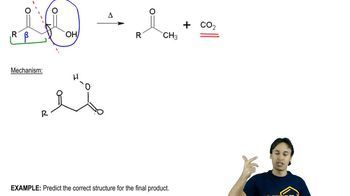
Arrow-Pushing Mechanism

Arrow-pushing mechanisms are diagrams used in organic chemistry to illustrate the movement of electrons during chemical reactions. Arrows indicate the direction of electron flow, showing how bonds are formed or broken. Understanding this mechanism is crucial for visualizing reaction pathways and predicting the products of reactions.
추천 영상:
04:32
General Mechanism

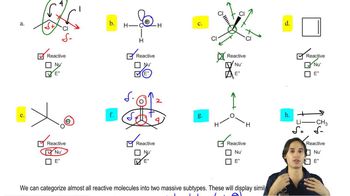
Nucleophiles and Electrophiles

Nucleophiles are species that donate an electron pair to form a chemical bond, while electrophiles are electron-deficient species that accept an electron pair. Recognizing the roles of nucleophiles and electrophiles in a reaction is essential for understanding how reactants interact and transform into products during the arrow-pushing process.
추천 영상:
03:
Nucleophile or Electrophile

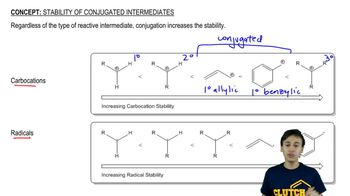
Reaction Intermediates

Reaction intermediates are transient species that form during the conversion of reactants to products. They are often unstable and exist only for a short time. Identifying these intermediates can help in understanding the stepwise nature of a reaction and the overall mechanism, which is critical for accurately depicting the arrow-pushing process.
추천 영상:
04:31
Stability of Conjugated Intermediates