Ch. 4 - Acids and Bases/Electron Flow
Mullins - Organic Chemistry: A Learner Centered Approach 1st Edition
Mullins1st EditionOrganic Chemistry: A Learner Centered ApproachISBN: 9780137566471당신이 사용하는 게 아니라요?교과서 변경
3장, 문제 37c

Using qualitative reasoning for the acid–base reactions shown,
(i) which is stronger, the base or the conjugate base?
(ii) Which side of the reaction is favored?
(iii) Would you expect a Keq greater than or less than 1?
(c)

검증된 단계별 안내
1
Step 1: Analyze the acid-base reaction provided. The reaction involves Cl⁻ (base) reacting with H₃O⁺ (acid) to form H₂O and HCl. Identify the base (Cl⁻) and the conjugate base (H₂O).
Step 2: Compare the strengths of the base (Cl⁻) and the conjugate base (H₂O). H₂O is a neutral molecule and is generally weaker as a base compared to Cl⁻, which is an anion and has a stronger tendency to accept protons.
Step 3: Determine which side of the reaction is favored. Since HCl is a strong acid, it dissociates almost completely in water, favoring the formation of H₃O⁺ and Cl⁻. This indicates that the equilibrium lies to the left side of the reaction.
Step 4: Use the equilibrium constant (Keq) to predict whether it is greater than or less than 1. Since the reaction favors the left side (reactants), the equilibrium constant (Keq) would be less than 1.
Step 5: Summarize the reasoning: The base (Cl⁻) is stronger than the conjugate base (H₂O). The reaction favors the left side (reactants), and the equilibrium constant (Keq) is expected to be less than 1.

비슷한 문제에 대한 검증된 영상 답변:

이 영상 해법은 위 문제에 도움이 된다고 튜터들이 추천한 것입니다.
영상 길이:
4m
도움이 되었나요?

주요 개념

질문에 올바르게 답하기 위해 반드시 이해해야 하는 핵심 개념들은 다음과 같습니다.

Acid-Base Theory

Acid-base theory explains the behavior of acids and bases in chemical reactions. According to the Brønsted-Lowry theory, acids are proton donors while bases are proton acceptors. In the given reaction, H3O+ acts as an acid by donating a proton, while Cl- acts as a base by accepting it. Understanding this theory is crucial for analyzing the strength of acids and bases in reactions.
추천 영상:
02:49
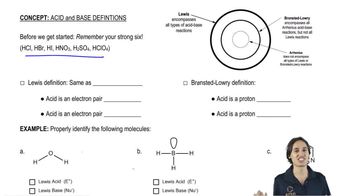
The Lewis definition of acids and bases.

Conjugate Acid-Base Pairs

Conjugate acid-base pairs consist of two species that differ by the presence of a proton (H+). When an acid donates a proton, it forms its conjugate base, while the base that accepts the proton becomes its conjugate acid. In the reaction shown, HCl is the conjugate acid of Cl-, and H2O is the conjugate base of H3O+. Recognizing these pairs helps in determining the relative strengths of acids and bases.
추천 영상:
가이드 코스
2:56
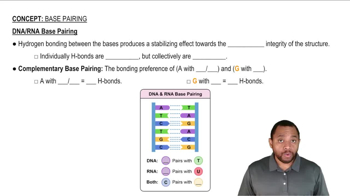
Base Pairing Concept 1

Equilibrium and Reaction Favorability

In acid-base reactions, the position of equilibrium indicates which side is favored. The stronger acid and stronger base will favor the formation of the weaker acid and weaker base. The equilibrium constant (K) can be used to quantify this favorability; if K is greater than 1, the products are favored, while if less than 1, the reactants are favored. This concept is essential for predicting the outcome of acid-base reactions.
추천 영상:
04:00
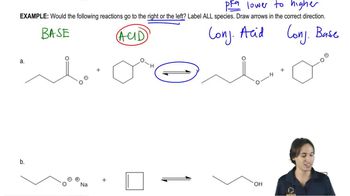
Determining Acid/Base Equilibrium