Ch. 4 - Acids and Bases/Electron Flow
Mullins - Organic Chemistry: A Learner Centered Approach 1st Edition
Mullins1st EditionOrganic Chemistry: A Learner Centered ApproachISBN: 9780137566471당신이 사용하는 게 아니라요?교과서 변경
3장, 문제 46b

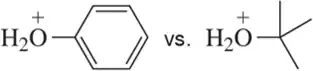
Which acid in each pair would you expect to more readily donate a proton to a basic compound?
(b) Chemical structures comparing two acids, highlighting their ability to donate protons to a basic compound.

검증된 단계별 안내
1
Step 1: Understand the concept of acidity. Acidity is the ability of a compound to donate a proton (H⁺). The strength of an acid depends on factors such as the stability of the conjugate base, electronegativity, resonance, and inductive effects.
Step 2: Analyze the pair of acids provided in the problem. Compare their molecular structures and identify any differences in electronegativity, resonance stabilization, or inductive effects that could influence their ability to donate a proton.
Step 3: Consider the stability of the conjugate base formed after the acid donates a proton. A more stable conjugate base indicates a stronger acid because the proton is more readily donated.
Step 4: Evaluate the role of electronegativity. If one acid has an atom with higher electronegativity near the acidic proton, it can stabilize the conjugate base through inductive effects, making the acid stronger.
Step 5: Assess resonance effects. If the conjugate base of one acid can delocalize its negative charge through resonance, it will be more stable, and the corresponding acid will more readily donate a proton.

비슷한 문제에 대한 검증된 영상 답변:

이 영상 해법은 위 문제에 도움이 된다고 튜터들이 추천한 것입니다.
영상 길이:
5m

주요 개념

질문에 올바르게 답하기 위해 반드시 이해해야 하는 핵심 개념들은 다음과 같습니다.

Acid Strength

Acid strength refers to the ability of an acid to donate protons (H+) to a base. Strong acids, such as hydrochloric acid (HCl), dissociate completely in water, releasing more protons compared to weak acids like acetic acid (CH3COOH), which only partially dissociate. The strength of an acid is often measured by its dissociation constant (Ka), with higher values indicating stronger acids.
추천 영상:
03:09
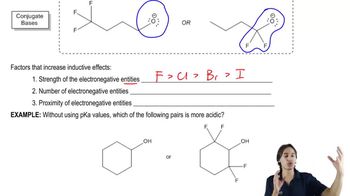
The 3 factors that determine the strength of inductive effects.

pKa Value

The pKa value is a logarithmic scale that indicates the strength of an acid; it is the negative logarithm of the acid dissociation constant (Ka). A lower pKa value signifies a stronger acid, which is more likely to donate a proton. Understanding pKa values helps predict the behavior of acids in various chemical reactions, particularly in comparing the acidity of different compounds.
추천 영상:
07:45
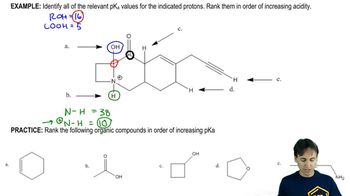
Identifying pKa values

Equilibrium and Le Chatelier's Principle

Equilibrium in acid-base reactions involves the balance between the acid and its conjugate base. According to Le Chatelier's Principle, if a system at equilibrium is disturbed, it will shift to counteract the disturbance. In the context of acids donating protons, a stronger acid will shift the equilibrium towards the products, favoring proton donation when reacting with a base.
추천 영상:
04:00
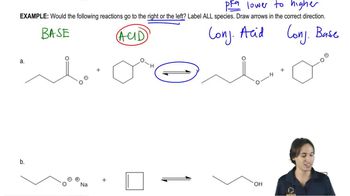
Determining Acid/Base Equilibrium