Ch. 4 - Acids and Bases/Electron Flow
Mullins - Organic Chemistry: A Learner Centered Approach 1st Edition
Mullins1st EditionOrganic Chemistry: A Learner Centered ApproachISBN: 9780137566471당신이 사용하는 게 아니라요?교과서 변경
3장, 문제 44b

Without using pKa values, pick out the least reactive (most stable) base in each pair. Explain your answer.
(b)

검증된 단계별 안내
1
Step 1: Analyze the two bases provided in the image: one contains an oxygen atom with a negative charge (O⁻), and the other contains a sulfur atom with a negative charge (S⁻). Both are attached to a cyclopentane ring.
Step 2: Consider the periodic trends in electronegativity. Oxygen is more electronegative than sulfur, meaning it has a stronger tendency to attract electrons and stabilize the negative charge. This makes the oxygen-based base less reactive compared to sulfur.
Step 3: Evaluate the size of the atoms. Sulfur is larger than oxygen, which allows the negative charge to be spread over a larger area. This delocalization can contribute to stability, but sulfur's lower electronegativity makes it less effective at stabilizing the charge compared to oxygen.
Step 4: Consider the polarizability of the atoms. Sulfur is more polarizable due to its larger size, which can make it more reactive in certain chemical environments. Oxygen, being less polarizable, is generally more stable as a base.
Step 5: Conclude that the oxygen-based base (cyclopentanolate, O⁻) is the least reactive (most stable) base in this pair due to its higher electronegativity and better ability to stabilize the negative charge.

비슷한 문제에 대한 검증된 영상 답변:

이 영상 해법은 위 문제에 도움이 된다고 튜터들이 추천한 것입니다.
도움이 되었나요?

주요 개념

질문에 올바르게 답하기 위해 반드시 이해해야 하는 핵심 개념들은 다음과 같습니다.

Acid-Base Stability

The stability of a base is influenced by its ability to accept protons and the stability of the resulting conjugate acid. A more stable base will have a lower tendency to react with protons, making it less reactive. Factors such as electronegativity, resonance, and inductive effects play crucial roles in determining this stability.
추천 영상:
02:49
The Lewis definition of acids and bases.

Resonance Effects

Resonance refers to the delocalization of electrons across multiple atoms, which can stabilize a base. If a base can distribute its negative charge over several atoms through resonance, it becomes more stable and less reactive. This is particularly important in comparing bases that can or cannot participate in resonance.
추천 영상:
03:32
Understanding Resonance Effects

Inductive Effects

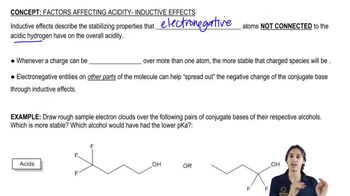
Inductive effects involve the transmission of charge through a chain of atoms in a molecule, influenced by electronegative atoms or groups. Electron-withdrawing groups can stabilize a negative charge on a base, making it less reactive. Understanding how these groups affect the stability of bases is essential for determining their reactivity.
추천 영상:
01:47
Understanding the Inductive Effect.