Ch. 5 - Chemical Reaction Analysis: Thermodynamics and Kinetics
Mullins - Organic Chemistry: A Learner Centered Approach 1st Edition
Mullins1st EditionOrganic Chemistry: A Learner Centered ApproachISBN: 9780137566471당신이 사용하는 게 아니라요?교과서 변경
4장, 문제 47c

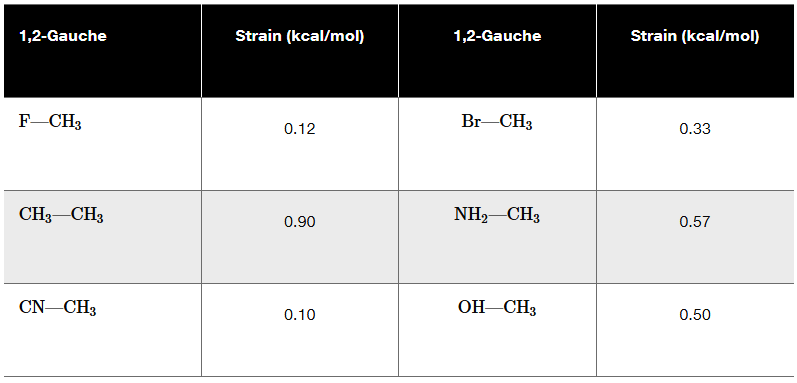
The following table of strain energies is associated with a variety of 1,2-gauche interactions. Use this table to answer the questions (i)–(iv).
Table displaying strain energies for various 1,2-gauche interactions in organic compounds.
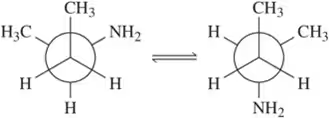
For each of the bond rotations shown, (i) identify which you believe to be more stable, (ii) calculate ∆G°, (iii) calculate the equilibrium constant, and (iv) draw the transition state.
(c) Structural diagram showing two conformations of a cycloalkane with substituents, illustrating barrier to rotation.

검증된 단계별 안내
1
Step 1: Begin by analyzing the given table of strain energies for 1,2-gauche interactions. Identify the specific strain energy values associated with the bond rotations in question (c). These values will be critical for calculating the stability and thermodynamic parameters.
Step 2: To determine which bond rotation is more stable (i), compare the strain energies of the two conformations. The conformation with the lower strain energy will be more stable because it experiences less steric hindrance or torsional strain.
Step 3: Calculate the Gibbs free energy change (∆G°) (ii) using the formula: ΔG°=Estrain(less−stable)−Estrain(more−stable). This equation subtracts the strain energy of the more stable conformation from the less stable conformation.
Step 4: Calculate the equilibrium constant (iii) using the relationship between ∆G° and the equilibrium constant: K=e(−ΔG°/RT), where R is the gas constant (8.314 J/mol·K) and T is the temperature (assumed to be 298 K). Plug in the calculated ∆G° value to find the equilibrium constant.
Step 5: Draw the transition state (iv) for the bond rotation. The transition state represents the highest energy point during the rotation process. Use your knowledge of molecular geometry and steric interactions to depict the arrangement of atoms and bonds in the transition state. Highlight any significant steric clashes or torsional strain that contribute to the energy barrier.

비슷한 문제에 대한 검증된 영상 답변:

이 영상 해법은 위 문제에 도움이 된다고 튜터들이 추천한 것입니다.
영상 길이:
4m

주요 개념

질문에 올바르게 답하기 위해 반드시 이해해야 하는 핵심 개념들은 다음과 같습니다.

Strain Energy

Strain energy refers to the energy stored in a molecule due to the distortion of its normal bond angles and lengths. In organic chemistry, this is particularly relevant in conformational analysis, where different spatial arrangements of atoms can lead to varying levels of stability. Understanding strain energy helps predict the stability of different conformers, such as those involved in 1,2-gauche interactions.
추천 영상:
02:46
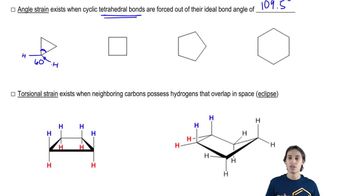
What is angle strain?

Gibbs Free Energy (∆G°)

Gibbs Free Energy (∆G°) is a thermodynamic potential that measures the maximum reversible work obtainable from a thermodynamic system at constant temperature and pressure. It is crucial for determining the spontaneity of a reaction; a negative ∆G° indicates a spontaneous process. In the context of bond rotations, calculating ∆G° helps assess the stability of different conformations.
추천 영상:
05:02
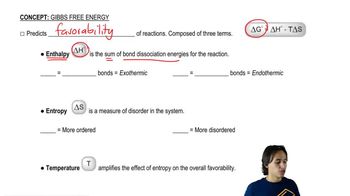
Breaking down the different terms of the Gibbs Free Energy equation.

Equilibrium Constant (K)

The equilibrium constant (K) quantifies the ratio of the concentrations of products to reactants at equilibrium for a reversible reaction. It is directly related to the Gibbs Free Energy change (∆G°) through the equation ∆G° = -RT ln(K), where R is the gas constant and T is the temperature in Kelvin. Understanding K is essential for predicting the favorability of different conformations in the context of bond rotations.
추천 영상:
02:19
The relationship between equilibrium constant and pKa.