Ch. 8 - Alkenes 1: Properties and Electrophilic Additions
Mullins - Organic Chemistry: A Learner Centered Approach 1st Edition
Mullins1st EditionOrganic Chemistry: A Learner Centered ApproachISBN: 9780137566471당신이 사용하는 게 아니라요?교과서 변경
7장, 문제 61b(vi)

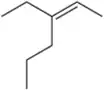
Predict the product(s) that would result when the alkenes shown here are allowed to react under the following conditions: (vi) 1. BH3 2. H2O2, NaOH
(b) Structural representation of alkenes for hydroboration reaction prediction.

검증된 단계별 안내
1
Step 1: Recognize the reaction type. The given conditions (1. BH₃, 2. H₂O₂, NaOH) indicate hydroboration-oxidation, which is a method for converting alkenes into alcohols.
Step 2: Understand the regioselectivity of hydroboration-oxidation. This reaction follows anti-Markovnikov addition, meaning the hydroxyl group (-OH) will attach to the less substituted carbon of the double bond.
Step 3: Consider the stereochemistry. Hydroboration-oxidation proceeds with syn addition, meaning the hydrogen and hydroxyl group will add to the same face of the alkene.
Step 4: Identify the structure of the starting alkene. Analyze the position of the double bond and determine which carbon is less substituted to predict where the hydroxyl group will attach.
Step 5: Draw the product. After determining the regioselectivity and stereochemistry, sketch the resulting alcohol, ensuring the hydroxyl group is on the less substituted carbon and both groups are added syn to each other.

비슷한 문제에 대한 검증된 영상 답변:

이 영상 해법은 위 문제에 도움이 된다고 튜터들이 추천한 것입니다.

주요 개념

질문에 올바르게 답하기 위해 반드시 이해해야 하는 핵심 개념들은 다음과 같습니다.

Hydroboration-Oxidation

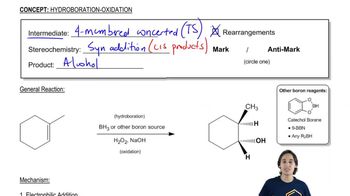
Hydroboration-oxidation is a two-step reaction process used to convert alkenes into alcohols. In the first step, borane (BH₃) adds across the double bond of the alkene, resulting in a trialkylborane intermediate. The second step involves oxidation with hydrogen peroxide (H₂O₂) in the presence of a base (NaOH), which converts the boron atom into a hydroxyl group, yielding an alcohol.
추천 영상:
06:38
General properties of hydroboration-oxidation.

Regioselectivity

Regioselectivity refers to the preference of a chemical reaction to yield one structural isomer over others when multiple products are possible. In hydroboration, the addition of borane occurs in a syn fashion, favoring the formation of the less substituted alcohol due to the mechanism's anti-Markovnikov nature, where the hydroxyl group ends up on the less substituted carbon of the alkene.
추천 영상:
05:09
Heck Reaction

Stereochemistry

Stereochemistry is the study of the spatial arrangement of atoms in molecules and how this affects their chemical behavior. In the hydroboration-oxidation reaction, the syn addition of borane leads to specific stereochemical outcomes, which can influence the properties and reactivity of the resulting alcohol. Understanding stereochemistry is crucial for predicting the 3D orientation of the product.
추천 영상:
가이드 코스
1:38
Polymer Stereochemistry Concept 1