Ch. 8 - Alkenes 1: Properties and Electrophilic Additions
Mullins - Organic Chemistry: A Learner Centered Approach 1st Edition
Mullins1st EditionOrganic Chemistry: A Learner Centered ApproachISBN: 9780137566471당신이 사용하는 게 아니라요?교과서 변경
7장, 문제 20c(b)

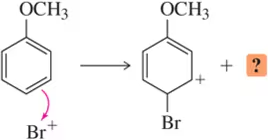
The following reaction steps are shown using conventional electron pushing. (b) Use the bouncing arrow formalism to illustrate the formation of only the product shown.
(c) Chemical reaction diagram showing electron movement from Br+ to form a product with two OCH3 groups and an unknown component.

검증된 단계별 안내
1
Step 1: Analyze the starting material, which is a cyclohexene ring with a double bond. The bromine atom (:Br) is shown with a lone pair of electrons and a positive charge, indicating it is an electrophile.
Step 2: Using the bouncing arrow formalism, illustrate the interaction between the π-electrons of the double bond in cyclohexene and the electrophilic bromine atom. The π-electrons will attack the bromine atom, forming a bond between one of the carbons in the double bond and the bromine.
Step 3: As the π-electrons attack the bromine, the double bond is broken, and a carbocation is formed on the adjacent carbon. This carbocation is stabilized by the structure of the cyclohexane ring.
Step 4: The bromine atom now forms a bond with one of the carbons from the original double bond, resulting in the bromine being attached to the cyclohexane ring. The carbocation remains on the adjacent carbon.
Step 5: The product shown in the image is a bromocyclohexane with a carbocation on the adjacent carbon. Ensure the bouncing arrow formalism clearly illustrates the movement of electrons during the reaction.

비슷한 문제에 대한 검증된 영상 답변:

이 영상 해법은 위 문제에 도움이 된다고 튜터들이 추천한 것입니다.
영상 길이:
3m
도움이 되었나요?

주요 개념

질문에 올바르게 답하기 위해 반드시 이해해야 하는 핵심 개념들은 다음과 같습니다.

Electron Pushing Mechanism

The electron pushing mechanism, often depicted with curved arrows, illustrates the movement of electron pairs during chemical reactions. This method helps visualize how nucleophiles attack electrophiles, leading to bond formation or breaking. Understanding this concept is crucial for predicting reaction outcomes and mechanisms in organic chemistry.
추천 영상:
03:54
The 18 and 16 Electron Rule

Bouncing Arrow Formalism

Bouncing arrow formalism is a specific representation used to depict the flow of electrons in a reaction, particularly in resonance structures or when showing the stabilization of charges. This method emphasizes the dynamic nature of electron movement, allowing chemists to visualize how intermediates and products are formed during a reaction. Mastery of this formalism is essential for accurately illustrating complex mechanisms.
추천 영상:
01:34
Calculating formal and net charge.

Electrophilic Addition Reactions

Electrophilic addition reactions involve the addition of an electrophile to a nucleophile, typically across a double bond. In the context of the provided reaction, a bromine molecule acts as the electrophile, adding to the alkene to form a bromoalkane. Understanding the nature of electrophiles and nucleophiles is fundamental for predicting the products of such reactions and their mechanisms.
추천 영상:
05:39
Features of Addition Mechanisms.