Ch. 9 - Alkenes 2: Oxidation and Reduction
Mullins - Organic Chemistry: A Learner Centered Approach 1st Edition
Mullins1st EditionOrganic Chemistry: A Learner Centered ApproachISBN: 9780137566471당신이 사용하는 게 아니라요?교과서 변경
8장, 문제 45d(i)

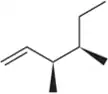
Predict the product(s) that would result when the alkenes are allowed to react under the following conditions: (i) Br2
(d) Chemical structure of an alkene with two double bonds, indicating potential sites for halogenation reactions.

검증된 단계별 안내
1
Step 1: Recognize the type of reaction. The reaction involves an alkene reacting with bromine (Br₂), which is a halogen addition reaction. This is a classic electrophilic addition reaction where bromine adds across the double bond of the alkene.
Step 2: Identify the mechanism. Bromine (Br₂) is a non-polar molecule, but when it approaches the electron-rich double bond of the alkene, it becomes polarized. The π-electrons of the alkene attack the bromine molecule, forming a bromonium ion intermediate.
Step 3: Understand the stereochemistry. The bromonium ion intermediate is cyclic and prevents free rotation. The second bromine ion (Br⁻) attacks the more accessible side of the bromonium ion, leading to anti-addition (the two bromine atoms add on opposite sides of the double bond).
Step 4: Predict the product. The final product will be a vicinal dibromide, where two bromine atoms are attached to adjacent carbons that were originally part of the double bond. The stereochemistry will be anti (opposite sides).
Step 5: Consider regioselectivity and stereochemistry. If the alkene is symmetrical, the product will be a single compound. If the alkene is asymmetrical, you may need to consider the specific structure of the alkene to determine the exact stereoisomers formed.

비슷한 문제에 대한 검증된 영상 답변:

이 영상 해법은 위 문제에 도움이 된다고 튜터들이 추천한 것입니다.
영상 길이:
2m
도움이 되었나요?

주요 개념

질문에 올바르게 답하기 위해 반드시 이해해야 하는 핵심 개념들은 다음과 같습니다.

Electrophilic Addition

Electrophilic addition is a fundamental reaction mechanism in organic chemistry where an electrophile reacts with a nucleophile, typically involving alkenes. In the case of alkenes reacting with Br₂, the double bond acts as a nucleophile, attacking the electrophilic bromine molecule, leading to the formation of a cyclic bromonium ion intermediate.
추천 영상:
09:23
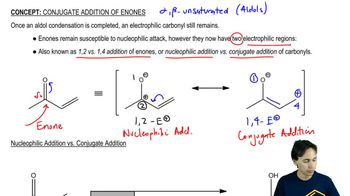
1,2 vs 1,4 Addition

Bromonium Ion Formation

The bromonium ion is a key intermediate formed during the reaction of alkenes with bromine. This three-membered ring structure stabilizes the positive charge on the bromine atom, allowing for the subsequent attack by a bromide ion. Understanding this intermediate is crucial for predicting the stereochemistry and regioselectivity of the final product.
추천 영상:
가이드 코스
3:39
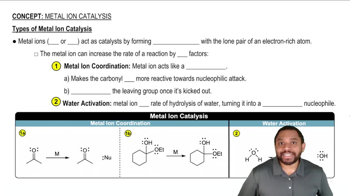
Metal Ion Catalysis Concept 1

Stereochemistry of Addition Reactions

Stereochemistry refers to the spatial arrangement of atoms in molecules and is particularly important in addition reactions involving alkenes. When Br₂ adds to an alkene, the reaction typically results in anti-addition, leading to the formation of vicinal dibromides with specific stereochemical configurations. Recognizing these configurations helps in predicting the final product's structure.
추천 영상:
가이드 코스
1:38
Polymer Stereochemistry Concept 1