Ch. 9 - Alkenes 2: Oxidation and Reduction
Mullins - Organic Chemistry: A Learner Centered Approach 1st Edition
Mullins1st EditionOrganic Chemistry: A Learner Centered ApproachISBN: 9780137566471당신이 사용하는 게 아니라요?교과서 변경
8장, 문제 45k(vii)

Predict the product(s) that would result when the alkenes are allowed to react under the following conditions: (vii) 1. mCPBA 2. H2SO4, H2O
(k) Chemical structure of a cyclohexene with two hydrogen atoms at the double bond, illustrating a reaction mechanism.

검증된 단계별 안내
1
Step 1: Recognize the reagents and their roles. mCPBA (meta-chloroperoxybenzoic acid) is a peracid commonly used for epoxidation of alkenes. This reaction adds an oxygen atom across the double bond to form an epoxide (a three-membered cyclic ether).
Step 2: Identify the structure of the alkene. Determine the position of the double bond in the given alkene structure. The double bond is the reactive site for the epoxidation reaction.
Step 3: Predict the stereochemistry of the epoxide. If the alkene is cis (Z-configuration), the epoxide will retain the cis stereochemistry. If the alkene is trans (E-configuration), the epoxide will retain the trans stereochemistry. This is due to the concerted mechanism of the reaction.
Step 4: Consider the second step (k). Without additional information about 'k', it is likely a placeholder for a subsequent reaction. If 'k' involves a nucleophile or acidic/basic conditions, the epoxide could undergo ring-opening to form a diol or other products. Clarify the conditions of step (k) to proceed further.
Step 5: Combine the information. Write the structure of the epoxide product from step 1 and consider any additional transformations based on the conditions of step (k). Ensure to account for regioselectivity and stereochemistry in the final product.

비슷한 문제에 대한 검증된 영상 답변:

이 영상 해법은 위 문제에 도움이 된다고 튜터들이 추천한 것입니다.
영상 길이:
3m
도움이 되었나요?

주요 개념

질문에 올바르게 답하기 위해 반드시 이해해야 하는 핵심 개념들은 다음과 같습니다.

Alkenes

Alkenes are hydrocarbons that contain at least one carbon-carbon double bond (C=C). They are unsaturated compounds, which means they have fewer hydrogen atoms than alkanes. The presence of the double bond makes alkenes reactive, allowing them to undergo various addition reactions, including those with oxidizing agents like mCPBA.
추천 영상:
가이드 코스
2:09
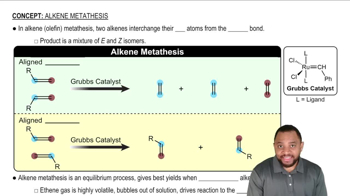
Alkene Metathesis Concept 1

mCPBA (meta-Chloroperbenzoic Acid)

mCPBA is a peracid commonly used in organic chemistry for the epoxidation of alkenes. It introduces an oxygen atom across the double bond, forming an epoxide, which is a three-membered cyclic ether. This reaction is stereospecific and can lead to different products depending on the substitution pattern of the alkene.
추천 영상:
02:48
O,P-positions vs. Meta-Positions

Epoxidation

Epoxidation is a chemical reaction that converts alkenes into epoxides through the addition of an oxygen atom. This reaction typically occurs under mild conditions and is important in organic synthesis because epoxides can be further transformed into a variety of functional groups. The stereochemistry of the starting alkene influences the configuration of the resulting epoxide.
추천 영상:
02:19
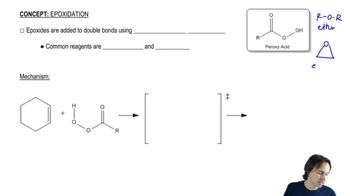
General properties of epoxidation.