Ch. 9 - Alkenes 2: Oxidation and Reduction
Mullins - Organic Chemistry: A Learner Centered Approach 1st Edition
Mullins1st EditionOrganic Chemistry: A Learner Centered ApproachISBN: 9780137566471당신이 사용하는 게 아니라요?교과서 변경
8장, 문제 45e(vii,viii)

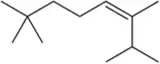
Predict the product(s) that would result when the alkenes are allowed to react under the following conditions: (vii) 1. mCPBA 2. (viii) 1. O3 2. CH3SCH3.
(e) Chemical structure of an alkene with highlighted hydrogenation sites for reaction prediction.

검증된 단계별 안내
1
Step 1: Analyze the given alkene structure. The molecule contains a double bond, which is the reactive site for the reactions described.
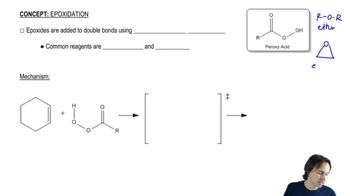
Step 2: For reaction (vii) with mCPBA, understand that mCPBA (meta-chloroperoxybenzoic acid) is a reagent used for epoxidation. It reacts with the double bond to form an epoxide. The oxygen from mCPBA is added across the double bond, creating a three-membered cyclic ether (epoxide).
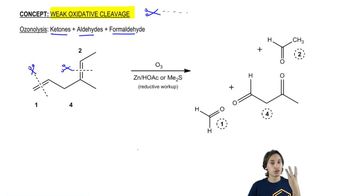
Step 3: For reaction (viii) with O₃ followed by CH₃SCH₃, recognize that this is an ozonolysis reaction. Ozone (O₃) cleaves the double bond, breaking it into two fragments. The second step with CH₃SCH₃ (dimethyl sulfide) is a reductive workup, which converts the ozonolysis products into aldehydes or ketones depending on the substitution pattern of the double bond.
Step 4: Determine the products for each reaction based on the structure of the alkene. For the epoxidation (vii), the double bond will form an epoxide. For the ozonolysis (viii), the double bond will be cleaved, and the resulting fragments will be aldehydes or ketones.
Step 5: Draw the products for each reaction. For (vii), draw the epoxide structure where the oxygen is added across the double bond. For (viii), draw the aldehyde or ketone fragments resulting from the cleavage of the double bond. Ensure the correct connectivity and substitution patterns are maintained in the products.

비슷한 문제에 대한 검증된 영상 답변:

이 영상 해법은 위 문제에 도움이 된다고 튜터들이 추천한 것입니다.

주요 개념

질문에 올바르게 답하기 위해 반드시 이해해야 하는 핵심 개념들은 다음과 같습니다.

Epoxidation

Epoxidation is a reaction where an alkene is converted into an epoxide, a three-membered cyclic ether. This transformation typically occurs using peracids, such as m-chloroperbenzoic acid (mCPBA). The reaction involves the electrophilic attack of the peracid on the double bond, resulting in the formation of the epoxide and a carboxylic acid byproduct.
추천 영상:
02:19
General properties of epoxidation.

Ozonolysis

Ozonolysis is a reaction involving the cleavage of alkenes using ozone (O₃) to form carbonyl compounds, such as aldehydes and ketones. The reaction proceeds through the formation of a molozonide intermediate, which rearranges to yield ozonides that can be further reduced. In this case, the presence of dimethyl sulfide (CH₃SCH₃) serves as a reducing agent to convert the ozonides into stable carbonyl products.
추천 영상:
06:30
General properties of ozonolysis.

Stereochemistry of Reactions

Stereochemistry refers to the spatial arrangement of atoms in molecules and how this affects their chemical behavior. In reactions involving alkenes, the stereochemistry can influence the products formed, especially in reactions like epoxidation and ozonolysis. Understanding the stereochemical outcomes is crucial for predicting the specific products, as different configurations can lead to different isomers.
추천 영상:
가이드 코스
1:38
Polymer Stereochemistry Concept 1