Ch. 9 - Alkenes 2: Oxidation and Reduction
Mullins - Organic Chemistry: A Learner Centered Approach 1st Edition
Mullins1st EditionOrganic Chemistry: A Learner Centered ApproachISBN: 9780137566471당신이 사용하는 게 아니라요?교과서 변경
8장, 문제 45f(ix,x)

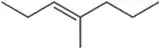
Predict the product(s) that would result when the alkenes are allowed to react under the following conditions: (ix) H2, Pd/C; and (x) D2, Pd/C.
(f) Structural representation of alkenes for hydrogenation reactions with H2 and D2 catalysts.

검증된 단계별 안내
1
Step 1: Analyze the given alkene structure. The molecule contains a double bond, which is the reactive site for hydrogenation reactions. The double bond is located between two carbon atoms in the structure.
Step 2: Understand the reaction conditions. (ix) H₂, Pd/C indicates catalytic hydrogenation using hydrogen gas and palladium on carbon as a catalyst. This reaction will convert the double bond into a single bond by adding hydrogen atoms to the carbons involved in the double bond.
Step 3: Predict the product for (ix). The double bond will be reduced to a single bond, and two hydrogen atoms will be added to the carbons that were part of the double bond. The stereochemistry of the product is typically not specified in catalytic hydrogenation unless the reaction is stereoselective.
Step 4: Understand the reaction conditions for (x). D₂, Pd/C indicates catalytic deuteration using deuterium gas (D₂) and palladium on carbon as a catalyst. This reaction is similar to hydrogenation but uses deuterium instead of hydrogen. The double bond will be reduced to a single bond, and two deuterium atoms will be added to the carbons involved in the double bond.
Step 5: Predict the product for (x). The double bond will be reduced to a single bond, and two deuterium atoms will be added to the carbons that were part of the double bond. The stereochemistry of the product is typically not specified unless the reaction is stereoselective.

비슷한 문제에 대한 검증된 영상 답변:

이 영상 해법은 위 문제에 도움이 된다고 튜터들이 추천한 것입니다.
영상 길이:
3m

주요 개념

질문에 올바르게 답하기 위해 반드시 이해해야 하는 핵심 개념들은 다음과 같습니다.

Hydrogenation of Alkenes

Hydrogenation is a chemical reaction that involves the addition of hydrogen (H₂) across the double bond of alkenes, converting them into alkanes. This reaction typically requires a catalyst, such as palladium on carbon (Pd/C), which facilitates the process by lowering the activation energy. The result is a saturated hydrocarbon, where the double bond is replaced by single bonds.
추천 영상:
00:48
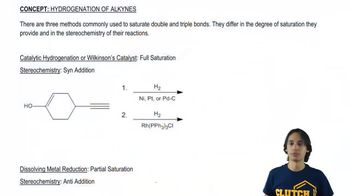
The definition of hydrogenation.

Deuteration of Alkenes

Deuteration is similar to hydrogenation but involves the addition of deuterium (D₂) instead of hydrogen. Deuterium is an isotope of hydrogen, and its incorporation into the alkene results in a product that contains deuterium atoms. This reaction also requires a catalyst like Pd/C and is useful in studies involving isotopic labeling in organic chemistry.
추천 영상:
가이드 코스
2:09
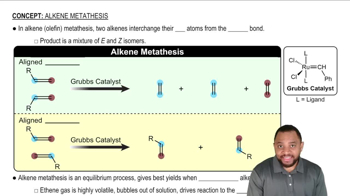
Alkene Metathesis Concept 1

Stereochemistry of Addition Reactions

The stereochemistry of addition reactions refers to the spatial arrangement of atoms in the product formed from the addition of reagents to alkenes. In hydrogenation and deuteration, the addition occurs in a syn fashion, meaning that both hydrogen or deuterium atoms add to the same side of the double bond. This can lead to specific stereoisomers, which are important in determining the properties and reactivity of the resulting compounds.
추천 영상:
가이드 코스
1:38
Polymer Stereochemistry Concept 1