
Ch. 9 - Alkenes 2: Oxidation and Reduction
Mullins - Organic Chemistry: A Learner Centered Approach 1st Edition
Mullins1st EditionOrganic Chemistry: A Learner Centered ApproachISBN: 9780137566471당신이 사용하는 게 아니라요?교과서 변경
8장, 문제 60b

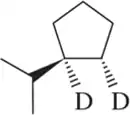
Retrosynthetic analysis is the process of working backward to develop the synthesis of a new compound. In Chapter 10, we begin developing multistep syntheses in this manner. For now, try to work backward a single step by suggesting an alkene and a reagent that would give products (a)–(i). [Your answers should not include alkenes that undergo rearrangement to give the desired products.]


(b) Chemical structure of a cyclopentane derivative with double bonds and deuterium labels indicating hydrogenation.

검증된 단계별 안내
1
Step 1: Understand the concept of retrosynthetic analysis. Retrosynthetic analysis involves breaking down a target molecule into simpler precursor molecules by working backward. This approach helps identify the starting materials and reagents needed for synthesis.
Step 2: Analyze the product (b) provided in the problem. Carefully examine its structure, functional groups, and stereochemistry to determine what type of reaction could produce it.
Step 3: Identify the reaction type that could lead to the formation of product (b). For example, if the product contains an alcohol group, it might have been formed via hydroboration-oxidation of an alkene. Alternatively, if the product contains a halogen, it might have been formed via halogenation of an alkene.
Step 4: Propose an alkene that could serve as the precursor to product (b). Ensure that the alkene does not undergo rearrangement during the reaction. Consider the regioselectivity and stereoselectivity of the reaction to match the structure of product (b).
Step 5: Suggest the reagent(s) required to convert the proposed alkene into product (b). For example, if the reaction involves hydroboration-oxidation, the reagents would be BH₃·THF followed by H₂O₂/NaOH. If halogenation is involved, the reagent might be Br₂ or Cl₂.

비슷한 문제에 대한 검증된 영상 답변:

이 영상 해법은 위 문제에 도움이 된다고 튜터들이 추천한 것입니다.
영상 길이:
1m
도움이 되었나요?

주요 개념

질문에 올바르게 답하기 위해 반드시 이해해야 하는 핵심 개념들은 다음과 같습니다.

Retrosynthetic Analysis

Retrosynthetic analysis is a strategic approach in organic chemistry where chemists deconstruct a target molecule into simpler precursor structures. This method allows for the identification of potential synthetic routes by working backward from the desired product to simpler starting materials. It emphasizes the importance of understanding functional groups and reaction mechanisms to effectively plan a synthesis.
추천 영상:
01:22
Retrosynthesis

Alkenes

Alkenes are hydrocarbons that contain at least one carbon-carbon double bond (C=C). They are key intermediates in organic synthesis due to their reactivity, which allows for various transformations, such as addition reactions. Understanding the properties and reactivity of alkenes is crucial for predicting the outcomes of reactions and selecting appropriate reagents in synthetic pathways.
추천 영상:
가이드 코스
2:09
Alkene Metathesis Concept 1

Reagents in Organic Synthesis

Reagents are substances used in chemical reactions to facilitate the transformation of reactants into products. In organic synthesis, the choice of reagent can significantly influence the reaction pathway and the final product. Familiarity with common reagents and their mechanisms of action is essential for successfully proposing synthetic routes and ensuring that the desired products are obtained without unwanted rearrangements.
추천 영상:
가이드 코스
1:16
Synthesis of Amino Acids: Strecker Synthesis Example 1
관련 실천
교과서 질문

Retrosynthetic analysis is the process of working backward to develop the synthesis of a new compound. In Chapter 10, we begin developing multistep syntheses in this manner. For now, try to work backward a single step by suggesting an alkene and a reagent that would give products (a)–(i). [Your answers should not include alkenes that undergo rearrangement to give the desired products.]

(i)

777
views
교과서 질문

Retrosynthetic analysis is the process of working backward to develop the synthesis of a new compound. In Chapter 10, we begin developing multistep syntheses in this manner. For now, try to work backward a single step by suggesting an alkene and a reagent that would give products (a)–(i). [Your answers should not include alkenes that undergo rearrangement to give the desired products.]

(a)

1592
views
교과서 질문

At the beginning of Chapter 9, we stated that after finishing Chapters 8 and 9, we would have the ability to make a large variety of functional groups using related reactions. Show the reagent(s) necessary to convert 1-isobutylcyclohexene into the following molecules.

(g)

1136
views
교과서 질문

At the beginning of Chapter 9, we stated that after finishing Chapters 8 and 9, we would have the ability to make a large variety of functional groups using related reactions. Show the reagent(s) necessary to convert 1-isobutylcyclohexene into the following molecules.

(h)

1055
views
교과서 질문

Retrosynthetic analysis is the process of working backward to develop the synthesis of a new compound. In Chapter 10, we begin developing multistep syntheses in this manner. For now, try to work backward a single step by suggesting an alkene and a reagent that would give products (a)–(i). [Your answers should not include alkenes that undergo rearrangement to give the desired products.]

(d)

1136
views
교과서 질문

Retrosynthetic analysis is the process of working backward to develop the synthesis of a new compound. In Chapter 10, we begin developing multistep syntheses in this manner. For now, try to work backward a single step by suggesting an alkene and a reagent that would give products (a)–(i). [Your answers should not include alkenes that undergo rearrangement to give the desired products.]

(f)

827
views