Ch. 9 - Alkenes 2: Oxidation and Reduction
Mullins - Organic Chemistry: A Learner Centered Approach 1st Edition
Mullins1st EditionOrganic Chemistry: A Learner Centered ApproachISBN: 9780137566471당신이 사용하는 게 아니라요?교과서 변경
8장, 문제 30a

Suggest a synthesis of the following aldehydes or ketones using the ozonolysis reaction of an alkene.
(a) Ozonolysis reaction of an alkene with O3 and CH3SCH3 yielding a cyclopentanone.

검증된 단계별 안내
1
Identify the target aldehyde or ketone structure that you need to synthesize. This will help you determine the alkene structure required for ozonolysis.
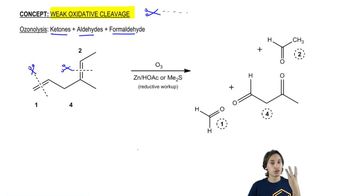
Understand the ozonolysis reaction: Ozonolysis involves the cleavage of alkenes using ozone (O₃) to form carbonyl compounds, such as aldehydes and ketones. The reaction typically proceeds through the formation of an ozonide intermediate, which is then reduced to yield the desired carbonyl products.
Determine the alkene structure: To synthesize a specific aldehyde or ketone, you need to identify the alkene that, upon ozonolysis, will yield the desired carbonyl compound. Consider the carbon chain length and the position of the double bond in the alkene that will lead to the formation of the target aldehyde or ketone.
Write the balanced chemical equation for the ozonolysis reaction: Represent the alkene and the ozone molecule in the equation, and show the formation of the ozonide intermediate. Then, indicate the reduction step that leads to the formation of the aldehyde or ketone.
Consider the reaction conditions: Ozonolysis typically requires a solvent like dichloromethane and a reducing agent such as zinc or dimethyl sulfide to convert the ozonide intermediate into the final carbonyl products. Ensure that these conditions are suitable for your synthesis.

비슷한 문제에 대한 검증된 영상 답변:

이 영상 해법은 위 문제에 도움이 된다고 튜터들이 추천한 것입니다.
영상 길이:
1m

주요 개념

질문에 올바르게 답하기 위해 반드시 이해해야 하는 핵심 개념들은 다음과 같습니다.

Ozonolysis Reaction

Ozonolysis is a reaction where ozone (O3) cleaves alkenes to form carbonyl compounds, such as aldehydes and ketones. The reaction involves the addition of ozone to the double bond, forming an ozonide intermediate, which is then reduced to yield the carbonyl products. This reaction is useful for breaking down complex alkenes into simpler carbonyl compounds.
추천 영상:
06:30
General properties of ozonolysis.

Alkenes

Alkenes are hydrocarbons containing at least one carbon-carbon double bond (C=C). They are unsaturated compounds, meaning they have fewer hydrogen atoms than alkanes. The double bond is a site of high reactivity, making alkenes suitable substrates for various addition reactions, including ozonolysis, which targets the double bond to form carbonyl compounds.
추천 영상:
가이드 코스
2:09
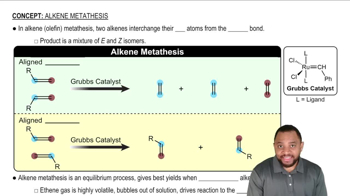
Alkene Metathesis Concept 1

Carbonyl Compounds

Carbonyl compounds are organic molecules containing a carbon-oxygen double bond (C=O), such as aldehydes and ketones. Aldehydes have at least one hydrogen atom attached to the carbonyl carbon, while ketones have two carbon groups. These compounds are key products in ozonolysis and are characterized by their distinct reactivity and chemical properties, which are crucial in organic synthesis.
추천 영상:
01:40
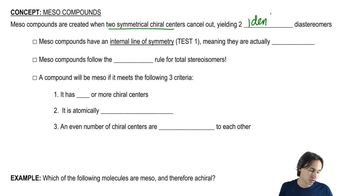
Defining meso compounds.