Ch. 9 - Alkenes 2: Oxidation and Reduction
Mullins - Organic Chemistry: A Learner Centered Approach 1st Edition
Mullins1st EditionOrganic Chemistry: A Learner Centered ApproachISBN: 9780137566471당신이 사용하는 게 아니라요?교과서 변경
8장, 문제 18b

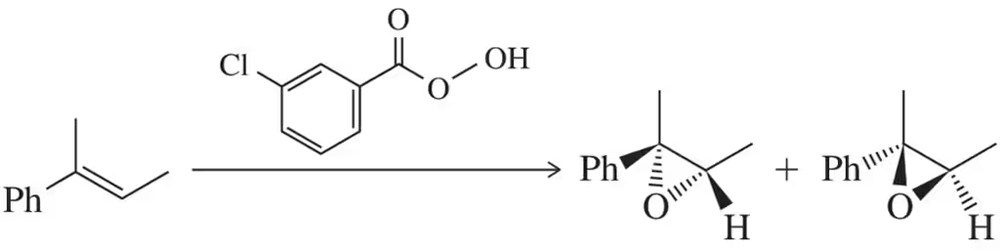
When producing a chiral molecule, epoxide formation still results in a mixture of enantiomers, despite its stereospecificity.
(b) How is it that a reaction can be stereospecific while still producing two enantiomers?
Chemical reaction diagram illustrating epoxide formation, showing reactants and resulting enantiomers.

검증된 단계별 안내
1
Step 1: Analyze the reaction provided in the image. The starting material is an alkene (with a phenyl group attached), and the reagent is m-chloroperbenzoic acid (mCPBA), which is commonly used for epoxidation reactions. The products are two enantiomers of an epoxide.
Step 2: Understand the concept of stereospecificity. A stereospecific reaction is one in which the stereochemistry of the reactant determines the stereochemistry of the product. In this case, the alkene undergoes epoxidation, and the stereochemistry of the double bond influences the formation of the epoxide.
Step 3: Explain why two enantiomers are formed. The alkene is planar, meaning it has no inherent chirality. When the mCPBA approaches the double bond, it can attack from either the top face or the bottom face of the planar alkene. This leads to the formation of two enantiomers, as the epoxide ring can form with opposite configurations depending on the face of attack.
Step 4: Clarify the stereospecificity aspect. Despite the formation of two enantiomers, the reaction is still stereospecific because the stereochemistry of the starting alkene dictates the relative stereochemistry of the products. For example, if the alkene had substituents that created a cis or trans configuration, the epoxide products would reflect that configuration.
Step 5: Summarize the key point. A reaction can be stereospecific while producing enantiomers because the stereospecificity refers to the relationship between the reactant and product stereochemistry, not the exclusivity of a single stereoisomer. The planar nature of the alkene allows for attack from both faces, resulting in a racemic mixture of enantiomers.

비슷한 문제에 대한 검증된 영상 답변:

이 영상 해법은 위 문제에 도움이 된다고 튜터들이 추천한 것입니다.
영상 길이:
4m
도움이 되었나요?

주요 개념

질문에 올바르게 답하기 위해 반드시 이해해야 하는 핵심 개념들은 다음과 같습니다.

Chirality

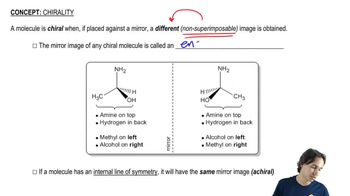
Chirality refers to the geometric property of a molecule that makes it non-superimposable on its mirror image, much like left and right hands. Chiral molecules typically have at least one carbon atom bonded to four different substituents, leading to two distinct configurations known as enantiomers. Understanding chirality is essential for grasping how certain reactions can yield different stereoisomers.
추천 영상:
05:10
What is chirality?

Stereospecificity

Stereospecificity is a characteristic of certain chemical reactions where the reactants lead to a specific stereoisomer of the product. In stereospecific reactions, the mechanism dictates the spatial arrangement of atoms, resulting in a preferred configuration. However, even stereospecific reactions can produce a mixture of enantiomers if the starting material is not entirely chiral or if the reaction conditions allow for different pathways.
추천 영상:
15:39
Box-Out Method and Full-Mechanism

Epoxide Formation

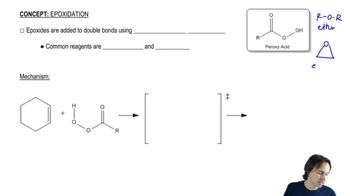
Epoxide formation involves the creation of a three-membered cyclic ether, which can occur through various mechanisms, often involving the reaction of alkenes with peracids. While the formation of epoxides can be stereospecific, the presence of a prochiral center or the reaction conditions can lead to the generation of both enantiomers. This illustrates how a stereospecific reaction can still yield a racemic mixture when starting materials or conditions allow for such outcomes.
추천 영상:
02:19
General properties of epoxidation.