Back
Back
Problem 1
Which of the following options include prokaryotic cells? Select all that apply.
a. Eukarya
b. Archaea
c. Protista
d. Bacteria
e. Fungi
Problem 2
Bacteria cell walls tend to contain:
a. Peptidoglycan.
b. Lipid bilayers.
c. Cholesterol.
d. Pseudomurein.
e. Flagellin.
Problem 3
Select any of the following characteristics that would NOT apply to prokaryotes.
a. Generally simpler than eukaryotes
b. Multicellular
c. Lack a true nucleus
d. Tend to have a single circular chromosome
e. Often lack a cell wall
f. All make endospores
g. Divide by mitosis
h. Includes the Domain Archaea
i. Includes the Domain Bacteria
j. Includes the Domain Eukarya
Problem 4
Indicate the true statements about prokaryotic cells, and then reword the false statements so that they are true.
a. They have 80S ribosomes.
b. They sexually reproduce by meiosis.
c. Cell walls underlie the plasma membrane.
d. They synthesize proteins with the help of ribosomes.
e. They can store nutrients in inclusion bodies.
f. Fimbriae are used for motility.
g. Archaea and Bacteria can be classified using the Gram stain.
Problem 5
Archaea cell walls tend to contain:
a. Lipid bilayers.
b. Pseudopeptidoglycan.
c. Cholesterol.
d. Flagellin.
e. Peptidoglycan.
Problem 6
What is the flagella arrangement for each of the pictured bacteria? <IMAGE>
Problem 7
State the shape and arrangement of the pictured bacterial samples. <IMAGE>
Problem 8
Which of the following would you expect to find in acid-fast cell walls? Select all that
apply.
a. Peptidoglycan
b. Phospholipids
c. Lipopolysaccharide
d. Lipid A
e. Mycolic acid
Problem 9
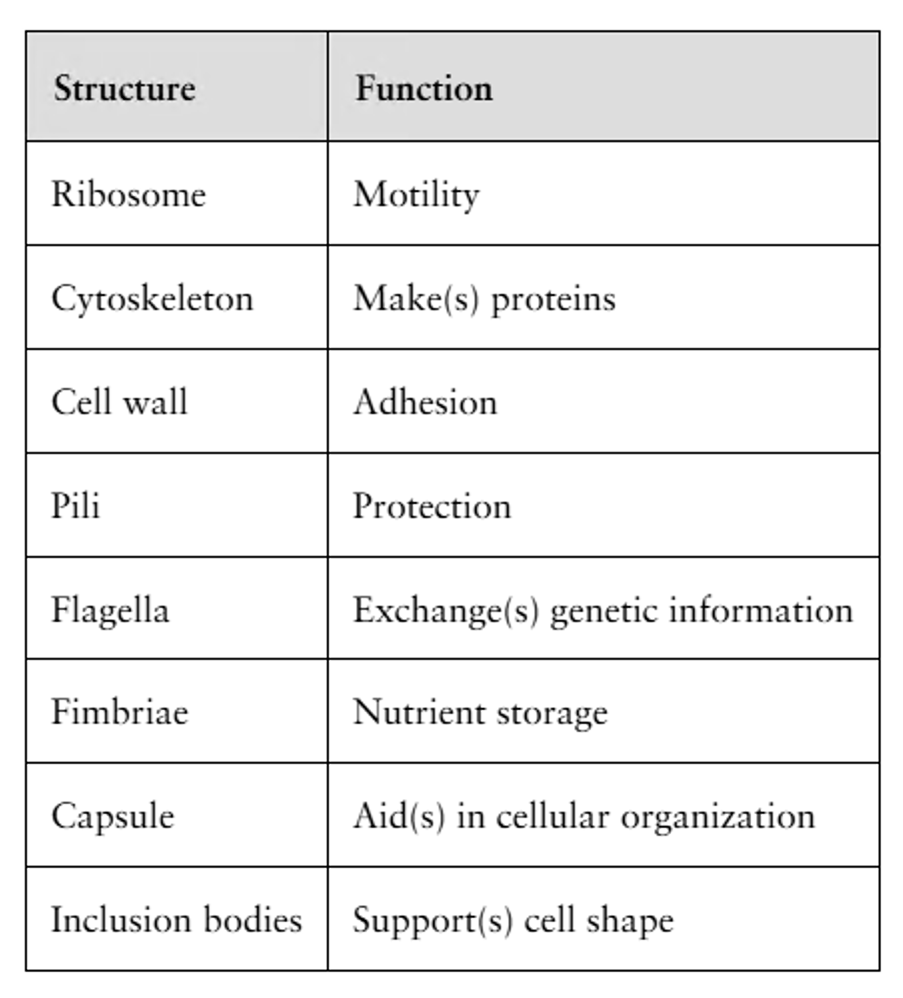
Match the cellular structures to their functions. Many statements will be used more than once; some structures may be matched to more than one functional description.
Problem 10
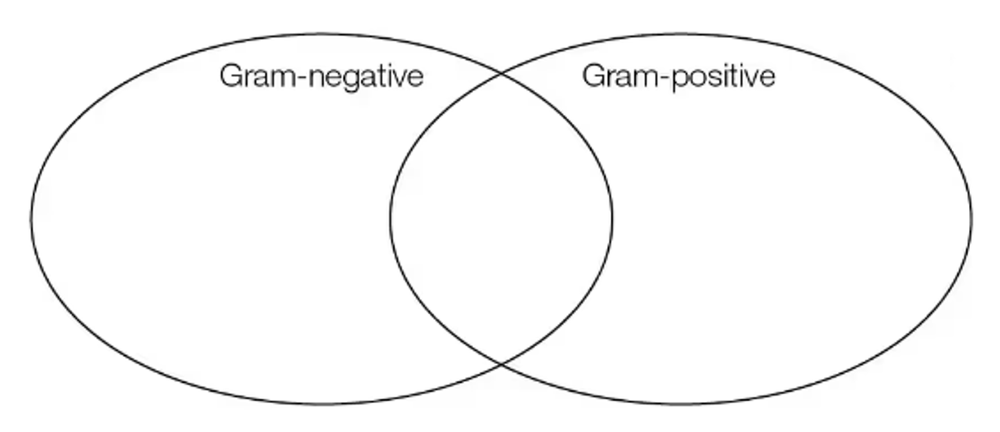
Complete the Venn diagram that compares and contrasts Gram-positive and Gram-negative bacteria.
Problem 11
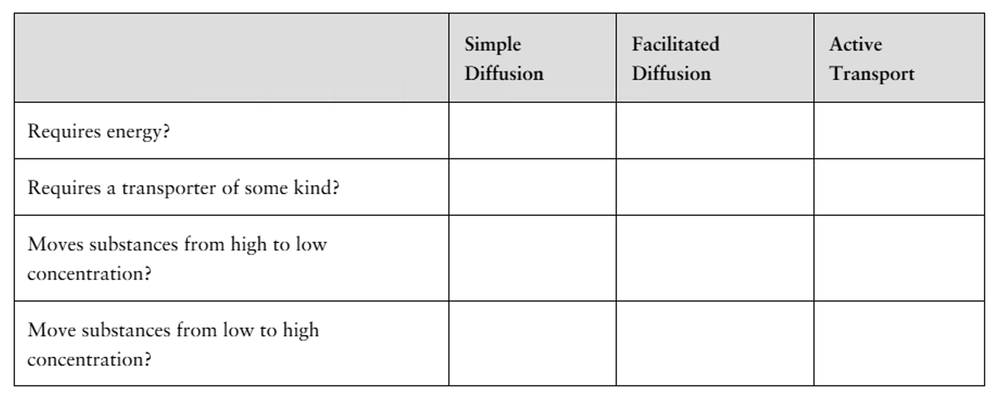
Complete the table by answering yes or no for each question.
Problem 12
Certain bacteria can form endospores in order to __________________.
a. Reproduce
b. Survive harsh conditions
c. Cause recurrent infections
d. Adhere to host tissues
e. Avoid the immune system of a host
Problem 13
Describe what would occur if a cell with a damaged cell wall was placed in each of the following environments:
- Isotonic environment
- Hypertonic environment
- Hypotonic environment
Problem 14
Which of the following characteristics regarding prokaryotic ribosomes supports the endosymbiotic theory?
a. Prokaryotic ribosomes are 80S just like eukaryotic ribosomes.
b. Prokaryotic ribosomes are 70S just like mitochondrial ribosomes.
c. Prokaryotic ribosomes make proteins in a similar manner to eukaryotic ribosomes.
d. Prokaryotic ribosomes have two subunits like eukaryotic ribosomes.
e. Prokaryotic ribosomes are intracellular structures like eukaryotic ribosomes.
Problem 15
Prokaryotic flagella are made of a protein called _________________.
Problem 16
Which of the following are true regarding osmosis? Select all that apply.
a. It is driven by differences in solute concentration.
b. It is the same as simple diffusion except it involves water.
c. It involves a selectively permeable membrane.
d. It requires energy to occur.
e. It requires specific channels.
f. Water moves from areas of high solute to areas of low solute.
g. Salt moves from high-water to low-water areas.
h. Water moves from areas of low solute to areas of high solute.
Problem 17
Which of the following are true regarding Mycoplasma bacteria? Select all that apply.
a. They have cholesterol in their plasma membranes.
b. They are among the largest bacteria characterized to date.
c. They are pleomorphic.
d. They are also called L-forms.
e. They were initially thought to be viruses.
f. Some can act as pathogens.
g. They are classified in domain Archaea.
h. They are prokaryotes.
i. They are sensitive to penicillin-based drugs.