Ch. 7 - The Reactions of Alkynes • An Introduction to Multistep Synthesis
Bruice - Organic Chemistry 8th Edition
Bruice8th EditionOrganic ChemistryISBN: 9780135213711Not the one you use?Change textbook
Chapter 8, Problem 1a,b

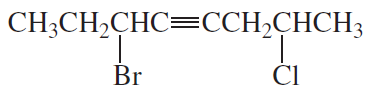
Name the following:
a. Chemical structure of a brominated alkene with a triple bond, labeled for identification.
b. Structural formula showing a compound with bromine and chlorine substituents on a carbon chain.

Verified step by step guidance
1
Step 1: Analyze the structure in part (i). The molecule contains a terminal alkyne group (-C≡CH) and a chlorine atom attached to the first carbon in the chain. The longest carbon chain containing the alkyne group is identified, and the chain is numbered starting from the end closest to the alkyne group.
Step 2: Assign the locants and name the substituents for part (i). The chlorine atom is attached to the first carbon in the chain, and the alkyne group starts at the third carbon. Combine these details to form the name of the compound.
Step 3: Analyze the structure in part (ii). The molecule contains an internal alkyne group (-C≡C-) and two chlorine atoms attached to the chain. The longest carbon chain containing the alkyne group is identified, and the chain is numbered starting from the end closest to the alkyne group.
Step 4: Assign the locants and name the substituents for part (ii). The chlorine atoms are attached to the second and sixth carbons in the chain, and the alkyne group starts at the fourth carbon. Combine these details to form the name of the compound.
Step 5: Ensure the names follow IUPAC nomenclature rules, including proper placement of locants, substituents, and the suffix for the alkyne group (-yne). Double-check for any stereochemical considerations if applicable.

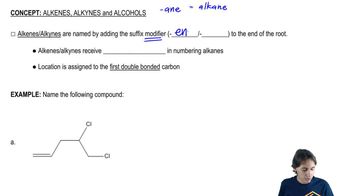
Verified video answer for a similar problem:

This video solution was recommended by our tutors as helpful for the problem above.
Video duration:
3m
Was this helpful?

Key Concepts

Here are the essential concepts you must grasp in order to answer the question correctly.

Alkene and Alkyne Nomenclature

In organic chemistry, alkenes and alkynes are hydrocarbons containing carbon-carbon double and triple bonds, respectively. The IUPAC naming system requires identifying the longest carbon chain containing the double or triple bond, using suffixes like '-ene' for alkenes and '-yne' for alkynes. Additionally, the position of the double or triple bond is indicated by the lowest possible number assigned to the first carbon involved in the bond.

Recommended video:
Guided course
01:55
How to name alkenes and alkynes

Substituents and Functional Groups

Substituents are atoms or groups of atoms that replace hydrogen atoms in a hydrocarbon chain, influencing the compound's properties and reactivity. In the provided structures, chlorine atoms are substituents that can affect the compound's reactivity and polarity. Understanding how to identify and name these substituents is crucial for accurately naming organic compounds.
Recommended video:
Guided course
02:36
Identifying Functional Groups

Stereochemistry

Stereochemistry involves the study of the spatial arrangement of atoms in molecules and how this affects their chemical behavior. In compounds with double bonds, such as alkenes, cis-trans isomerism can occur, where substituents can be on the same side (cis) or opposite sides (trans) of the double bond. Recognizing these configurations is essential for understanding the properties and reactivity of the compounds.
Recommended video:
1:38
Polymer Stereochemistry Concept 1