Ch. 14 - NMR Spectroscopy
Bruice - Organic Chemistry 8th Edition
Bruice8th EditionOrganic ChemistryISBN: 9780135213711Not the one you use?Change textbook
Chapter 15, Problem 33b

Which pairs are diastereotopic hydrogens?

Verified step by step guidance
1
Identify the molecule in question and determine if it contains stereocenters or double bonds, as these are necessary for hydrogens to be diastereotopic.
Locate the hydrogens attached to the same carbon atom. Diastereotopic hydrogens arise when replacing one hydrogen with a different group creates diastereomers.
Check if the carbon atom to which the hydrogens are attached is adjacent to a stereocenter or part of a chiral environment. This is a key condition for diastereotopicity.
Perform a thought experiment: Replace each hydrogen one at a time with a different group (e.g., a deuterium atom) and analyze the resulting molecules. If the two resulting molecules are diastereomers (non-mirror image stereoisomers), the hydrogens are diastereotopic.
Confirm the diastereotopic relationship by considering the NMR spectrum. Diastereotopic hydrogens typically show different chemical shifts in an NMR spectrum due to their distinct environments.

Verified video answer for a similar problem:

This video solution was recommended by our tutors as helpful for the problem above.
Video duration:
8m
Was this helpful?

Key Concepts

Here are the essential concepts you must grasp in order to answer the question correctly.

Diastereotopic Hydrogens

Diastereotopic hydrogens are pairs of hydrogen atoms that are not equivalent due to the presence of a chiral center or other stereogenic elements in a molecule. When one hydrogen atom in a pair can be replaced by a different atom or group, leading to diastereomers, the two hydrogens are considered diastereotopic. This concept is crucial for understanding stereochemistry and the reactivity of molecules.
Recommended video:
Guided course
00:48
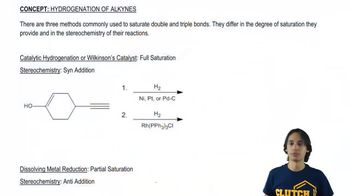
The definition of hydrogenation.

Stereoisomerism

Stereoisomerism refers to the phenomenon where compounds have the same molecular formula and connectivity of atoms but differ in the spatial arrangement of those atoms. This includes both enantiomers, which are non-superimposable mirror images, and diastereomers, which are not mirror images. Understanding stereoisomerism is essential for identifying diastereotopic hydrogens and their implications in chemical reactions.
Recommended video:
Guided course
01:58
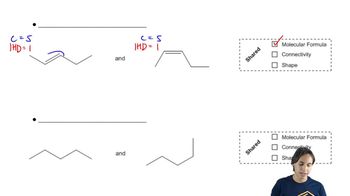
Determining when molecules are stereoisomers.

Chirality

Chirality is a property of a molecule that makes it non-superimposable on its mirror image, often due to the presence of a chiral center, typically a carbon atom bonded to four different substituents. Chirality is fundamental in organic chemistry as it influences the behavior of molecules in biological systems and their interactions. Recognizing chiral centers helps in determining the diastereotopic nature of hydrogens in a compound.
Recommended video:
Guided course
05:10
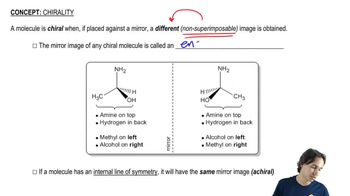
What is chirality?