Ch. 8 - Delocalized Electrons: Their Effect on Stability, pKa, and the Products of a Reaction • Aromaticity and Electronic Effects: An Introduction to the Reactions of Benzene
Bruice - Organic Chemistry 8th Edition
Bruice8th EditionOrganic ChemistryISBN: 9780135213711Not the one you use?Change textbook
Chapter 9, Problem 74

Which compound is the strongest base?

Verified step by step guidance
1
Step 1: Identify the functional groups in each compound. The compounds shown are pyridine (a nitrogen-containing aromatic ring), aniline (a benzene ring with an amino group), N-methylaniline (a benzene ring with a methylated amino group), and benzylamine (a benzene ring with a CH2-NH2 group).
Step 2: Recall the concept of basicity. Basicity is determined by the ability of a compound to donate a lone pair of electrons to accept a proton (H+). Factors such as resonance, inductive effects, and steric hindrance influence basicity.
Step 3: Analyze resonance effects. In aniline, the lone pair on the nitrogen can delocalize into the aromatic ring, reducing its availability to accept a proton. In pyridine, the nitrogen is part of the aromatic system, and its lone pair is less available for protonation due to resonance stabilization.
Step 4: Consider inductive effects. In benzylamine, the CH2 group attached to the benzene ring does not significantly withdraw electron density from the amino group, making the lone pair on the nitrogen more available for protonation. In N-methylaniline, the methyl group slightly increases electron density on the nitrogen, but resonance effects still reduce basicity.
Step 5: Compare steric hindrance. Benzylamine has minimal steric hindrance around the amino group, making it easier for the nitrogen to interact with a proton. This suggests benzylamine is likely the strongest base among the given compounds.

Verified video answer for a similar problem:

This video solution was recommended by our tutors as helpful for the problem above.
Video duration:
3m
Was this helpful?

Key Concepts

Here are the essential concepts you must grasp in order to answer the question correctly.

Acidity and Basicity

Acidity and basicity are fundamental concepts in organic chemistry that describe the tendency of a compound to donate or accept protons (H+ ions). A strong base is characterized by its ability to readily accept protons, while a strong acid readily donates protons. The strength of a base is often measured using the pKa scale, where lower pKa values indicate stronger acids and, conversely, higher pKa values suggest stronger bases.
Recommended video:
Guided course
06:21
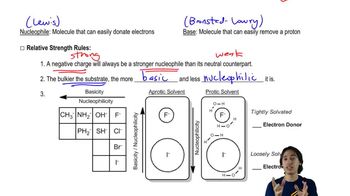
Understanding the difference between basicity and nucleophilicity.

Lewis Acids and Bases

The Lewis theory expands the definitions of acids and bases beyond protons. According to this theory, a Lewis acid is an electron pair acceptor, while a Lewis base is an electron pair donor. This broader definition allows for the classification of many compounds as bases based on their ability to donate electron pairs, which is crucial for understanding reactivity in organic reactions.
Recommended video:
Guided course
02:49
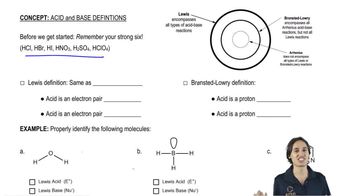
The Lewis definition of acids and bases.

Structure-Activity Relationship

The structure-activity relationship (SAR) is a principle that correlates the chemical structure of a compound with its biological activity or reactivity. In the context of basicity, the presence of electron-donating groups (like alkyl groups) can enhance a compound's ability to act as a base, while electron-withdrawing groups (like halogens) can diminish this ability. Understanding SAR helps predict which compound might be the strongest base based on its molecular structure.
Recommended video:
4:47
Metal Ion Catalysis: Water Activation Concept 2