
Ch. 6 - The Reactions of Alkenes • The Stereochemistry of Addition Reactions
Bruice - Organic Chemistry 8th Edition
Bruice8th EditionOrganic ChemistryISBN: 9780135213711Not the one you use?Change textbook
Chapter 6, Problem 70a(3)

Draw the product or products that will be obtained from the reaction of cis-2-butene and trans-2-butene with each of the following reagents. If a product can exist as stereoisomers, show which stereoisomers are formed.
3. a peroxyacid

Verified step by step guidance
1
Understand the reaction: The reaction of an alkene with a peroxyacid (RCO₃H) results in the formation of an epoxide. This is an electrophilic addition reaction where the π-bond of the alkene reacts with the peroxyacid to form a three-membered cyclic ether (epoxide).
Analyze the starting materials: cis-2-butene and trans-2-butene are geometric isomers of 2-butene. Cis-2-butene has both methyl groups on the same side of the double bond, while trans-2-butene has the methyl groups on opposite sides of the double bond.
Predict the stereochemistry of the products: The stereochemistry of the starting alkene determines the stereochemistry of the epoxide. For cis-2-butene, the epoxide will be a cis-epoxide (both substituents on the same side of the ring). For trans-2-butene, the epoxide will be a trans-epoxide (substituents on opposite sides of the ring).
Draw the products: For cis-2-butene, draw a three-membered epoxide ring with both methyl groups on the same side. For trans-2-butene, draw a three-membered epoxide ring with the methyl groups on opposite sides. Ensure the stereochemistry is clearly indicated using wedge and dash bonds.
Verify stereoisomers: Since the products are epoxides, they can exist as stereoisomers. For cis-2-butene, the product will be a single stereoisomer (cis-epoxide). For trans-2-butene, the product will also be a single stereoisomer (trans-epoxide).

Verified video answer for a similar problem:

This video solution was recommended by our tutors as helpful for the problem above.
Video duration:
6m

Key Concepts

Here are the essential concepts you must grasp in order to answer the question correctly.

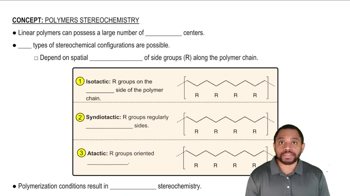
Alkenes and Stereochemistry

Alkenes are hydrocarbons that contain at least one carbon-carbon double bond. The stereochemistry of alkenes, such as cis and trans isomers, is crucial in determining the products of reactions. In this case, cis-2-butene has substituents on the same side of the double bond, while trans-2-butene has them on opposite sides, leading to different reactivity and product formation.
Recommended video:
Guided course
1:38
Polymer Stereochemistry Concept 1

Peroxyacid Reactions

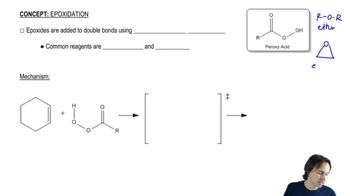
Peroxyacids, such as m-chloroperbenzoic acid (MCPBA), are strong oxidizing agents that can react with alkenes to form epoxides. This reaction involves the addition of an oxygen atom across the double bond, resulting in a three-membered cyclic ether. Understanding this mechanism is essential for predicting the products formed from the reaction of alkenes with peroxyacids.
Recommended video:
05:09
Heck Reaction

Stereoisomerism in Epoxides

Epoxides can exhibit stereoisomerism due to the presence of chiral centers formed during their synthesis. When alkenes like cis-2-butene and trans-2-butene react with a peroxyacid, the resulting epoxide can exist in different stereoisomeric forms. It is important to identify and represent these stereoisomers to fully describe the products of the reaction.
Recommended video:
02:19
General properties of epoxidation.