Ch. 2 - Acids and Bases: Central to Understanding Organic Chemistry
Bruice - Organic Chemistry 8th Edition
Bruice8th EditionOrganic ChemistryISBN: 9780135213711Not the one you use?Change textbook
Chapter 3, Problem 48a

Given the data in Problem 47:
a. What pH would you make the water layer to cause the carboxylic acid to dissolve in the water layer and the amine to dissolve in the ether layer?

Verified step by step guidance
1
Identify the functional groups in the compounds: A carboxylic acid contains a -COOH group, which can lose a proton (H⁺) to form a carboxylate anion (-COO⁻) in a basic environment. An amine contains a -NH₂ group, which can gain a proton to form an ammonium cation (-NH₃⁺) in an acidic environment.
Understand the solubility behavior: The carboxylate anion (-COO⁻) is water-soluble due to its ionic nature, while the neutral carboxylic acid is more soluble in organic solvents like ether. Similarly, the ammonium cation (-NH₃⁺) is water-soluble, while the neutral amine is more soluble in ether.
Determine the pH conditions for the carboxylic acid: To deprotonate the carboxylic acid and form the water-soluble carboxylate anion, the pH of the water layer should be made basic. This can be achieved by adding a base, such as NaOH, to raise the pH above the pKa of the carboxylic acid (typically around 4-5).
Determine the pH conditions for the amine: To keep the amine in its neutral form (which is ether-soluble), the pH of the water layer should not be too acidic. If the pH is below the pKa of the amine (typically around 9-11), the amine will protonate to form the water-soluble ammonium cation.
Adjust the pH accordingly: To achieve the desired separation, set the pH of the water layer to a value above the pKa of the carboxylic acid (e.g., pH > 5) but below the pKa of the amine (e.g., pH < 9). This ensures the carboxylic acid dissolves in the water layer as the carboxylate anion, while the amine remains in the ether layer in its neutral form.

Verified video answer for a similar problem:

This video solution was recommended by our tutors as helpful for the problem above.
Video duration:
6m
Was this helpful?

Key Concepts

Here are the essential concepts you must grasp in order to answer the question correctly.

Carboxylic Acids and pH

Carboxylic acids are weak acids that can donate protons (H+) in solution. The pH of a solution affects the ionization of these acids; at lower pH (more acidic), they remain mostly in their non-ionized form, while at higher pH, they can deprotonate to form carboxylate ions. To dissolve a carboxylic acid in water, the pH should be adjusted to a level that favors its ionization.
Recommended video:
Guided course
04:20
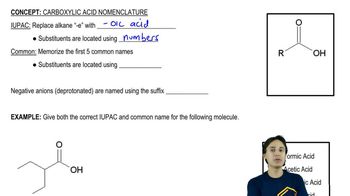
Carboxylic Acids Nomenclature

Amine Solubility in Organic Solvents

Amines are basic compounds that can accept protons, and their solubility in organic solvents like ether is influenced by their protonation state. At lower pH, amines are protonated and more soluble in water, while at higher pH, they are neutral and more soluble in organic solvents. Understanding this behavior is crucial for manipulating the solubility of amines in extraction processes.
Recommended video:
Guided course
02:01
Introducing common solvents and other molecules in organic chemistry.

Liquid-Liquid Extraction

Liquid-liquid extraction is a technique used to separate compounds based on their solubility in two different immiscible liquids, typically water and an organic solvent. The distribution of compounds between the two layers depends on their polarity and the pH of the aqueous layer. By adjusting the pH, one can selectively dissolve either the carboxylic acid in water or the amine in the organic layer, facilitating their separation.
Recommended video:
1:16
Triacylglycerols Example 2