Ch. 3 - An Introduction to Organic Compounds:Nomenclature, Physical Properties, and Structure
Bruice - Organic Chemistry 8th Edition
Bruice8th EditionOrganic ChemistryISBN: 9780135213711Not the one you use?Change textbook
Chapter 4, Problem 15e,f

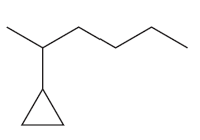
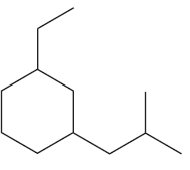
What is each compound's systematic name?
e. Structural formula of a cycloalkane with a branched chain, illustrating its molecular connectivity.
f. Chemical structure of a cycloalkane with labeled carbon atoms for systematic naming.

Verified step by step guidance
1
Step 1: Analyze the structure in (i). Identify the parent chain, which is the longest continuous chain of carbon atoms. In this case, the parent chain contains four carbon atoms, making it a butane derivative.
Step 2: Identify the substituents attached to the parent chain in (i). There is a cyclopropyl group attached to the second carbon of the butane chain.
Step 3: Assign the locant (position number) for the substituent in (i). The cyclopropyl group is attached to carbon-2 of the butane chain. The systematic name will include this locant.
Step 4: Analyze the structure in (ii). Identify the parent chain, which is the longest continuous chain of carbon atoms. In this case, the parent chain contains six carbon atoms, making it a hexane derivative.
Step 5: Identify the substituents attached to the parent chain in (ii). There is a methyl group attached to carbon-1 and a propyl group attached to carbon-3 of the hexane chain. Assign locants and combine them with the parent name to form the systematic name.

Verified video answer for a similar problem:

This video solution was recommended by our tutors as helpful for the problem above.
Video duration:
2m
Was this helpful?

Key Concepts

Here are the essential concepts you must grasp in order to answer the question correctly.

Systematic Naming

Systematic naming in organic chemistry refers to the IUPAC (International Union of Pure and Applied Chemistry) rules used to assign unique names to chemical compounds. This process involves identifying the longest carbon chain, determining the functional groups, and numbering the carbon atoms to provide a clear and unambiguous name that reflects the structure of the compound.
Recommended video:
Guided course
03:43
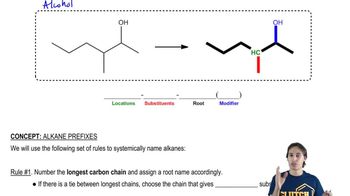
The different parts of an IUPAC name

Cycloalkanes

Cycloalkanes are a class of hydrocarbons characterized by carbon atoms arranged in a ring structure. They follow the general formula CnH2n and can be saturated or unsaturated. Understanding the structure of cycloalkanes is crucial for systematic naming, as the presence of rings affects the naming conventions and the identification of substituents.
Recommended video:
Guided course
01:11
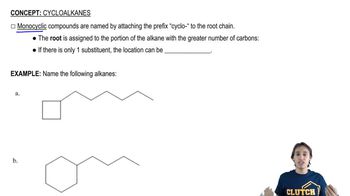
How to find the root name for cycloalkanes

Substituents and Their Position

Substituents are atoms or groups of atoms that replace hydrogen atoms in a hydrocarbon chain or ring. When naming compounds, it is essential to identify the type and position of these substituents, as they influence the compound's name. The position is indicated by numbering the carbon atoms in the main chain or ring, ensuring that the substituents are assigned the lowest possible numbers.
Recommended video:
4:06
Reactions at the Allylic Position Example 3