
Ch.5 - Stereochemistry
Wade - Organic Chemistry 9th Edition
Wade9th EditionOrganic ChemistryISBN: 9780135213728Not the one you use?Change textbook
Chapter 5, Problem 5

Make a model and draw a three-dimensional structure for each compound. Then draw the mirror image of your original structure and determine whether the mirror image is the same compound. Label each structure as being chiral or achiral, and label pairs of enantiomers.a. cis-1,2-dimethylcyclobutaneb. trans-1,2-dimethylcyclobutane

Verified step by step guidance
1
Start by drawing the basic cyclobutane ring structure for both compounds. Cyclobutane is a four-membered ring, so sketch a square to represent this.
For cis-1,2-dimethylcyclobutane, place the two methyl groups (CH₃) on adjacent carbon atoms (1 and 2) on the same side of the ring. This means both methyl groups will be either both above or both below the plane of the ring.
For trans-1,2-dimethylcyclobutane, place the two methyl groups on adjacent carbon atoms (1 and 2) on opposite sides of the ring. One methyl group will be above the plane of the ring, and the other will be below.
Draw the mirror image of each structure. For the cis isomer, the mirror image will have the methyl groups still on the same side, while for the trans isomer, the mirror image will have the methyl groups on opposite sides.
Determine chirality: cis-1,2-dimethylcyclobutane is achiral because it has a plane of symmetry. Trans-1,2-dimethylcyclobutane is also achiral because it has a center of symmetry. Therefore, neither compound has enantiomers.

Verified video answer for a similar problem:

This video solution was recommended by our tutors as helpful for the problem above.
Video duration:
5m
Was this helpful?

Key Concepts

Here are the essential concepts you must grasp in order to answer the question correctly.

Chirality

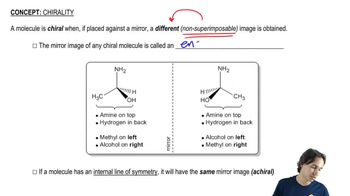
Chirality refers to the geometric property of a molecule that makes it non-superimposable on its mirror image. A chiral molecule typically has at least one carbon atom bonded to four different substituents, resulting in two distinct forms known as enantiomers. Understanding chirality is crucial for determining the optical activity and biological interactions of compounds.
Recommended video:
Guided course
05:10
What is chirality?

Enantiomers

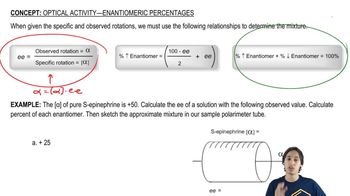
Enantiomers are a pair of chiral molecules that are mirror images of each other. They possess identical physical properties, such as melting and boiling points, but differ in their interaction with polarized light and in their reactivity in chiral environments. Identifying enantiomers is essential in organic chemistry, especially in pharmaceuticals, where different enantiomers can have vastly different biological effects.
Recommended video:
Guided course
03:23
How to solve for the percentage of each enantiomer.

Cis-Trans Isomerism

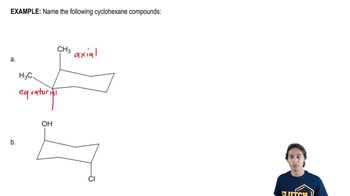
Cis-trans isomerism, also known as geometric isomerism, occurs in compounds with restricted rotation around a double bond or a ring structure. In the context of cyclobutane derivatives, 'cis' indicates that substituents are on the same side of the ring, while 'trans' indicates they are on opposite sides. This distinction is important for determining the overall symmetry and potential chirality of the molecule.
Recommended video:
Guided course
00:44
Is the following cyclohexane cis or trans?
Related Practice
Textbook Question
Draw a Fischer projection for each compound. Remember that the cross represents an asymmetric carbon atom, and the carbon chain should be along the vertical, with the IUPAC numbering from top to bottom.c. (S)-1,2-dibromobutaned. (R)-butan-2-ol
2136
views
Textbook Question
Draw three-dimensional representations of the following compounds. Which have asymmetric carbon atoms? Which have no asymmetric carbons but are chiral anyway? Use your models for parts (a) through (d) and any others that seem unclear.c. ClHC═C═C(CH3)21-chloro-3-methylbuta-1,2-diened. ClHC═CH―CH═CH21-chlorobuta-1,3-diene
1294
views
Textbook Question

For each of the stereocenters (circled) in Figure 5-5,

a. draw the compound with two of the groups on the stereocenter interchanged.

b. give the relationship of the new compound to the original compound.

1844
views
Textbook Question
In Problem 5-3 , you drew the enantiomers for a number of chiral compounds. Now go back and designate each asymmetric carbon atom as either (R) or (S).e. Chlorocyclohexane f. Cis-1,2-dichlorocyclobutane
1201
views
Textbook Question
Draw three-dimensional representations of the following compounds. Which have asymmetric carbon atoms? Which have no asymmetric carbons but are chiral anyway? Use your models for parts (a) through (d) and any others that seem unclear.a. ClHC═C═CHCl1,3-dichloropropadieneb. ClHC═C═CHCH31-chlorobuta-1,2-diene
1178
views
Textbook Question
Draw a Fischer projection for each compound. Remember that the cross represents an asymmetric carbon atom, and the carbon chain should be along the vertical, with the IUPAC numbering from top to bottom.a. (S)-propane-1,2-diolb. (R)-2-bromobutan-1-ol
2777
views
1
rank