Ch. 3 - An Introduction to Organic Compounds:Nomenclature, Physical Properties, and Structure
Bruice - Organic Chemistry 8th Edition
Bruice8th EditionOrganic ChemistryISBN: 9780135213711Not the one you use?Change textbook
Chapter 4, Problem 63h

Which has
h. the higher boiling point: diethyl ether or butyl alcohol?

Verified step by step guidance
1
Step 1: Understand the factors that influence boiling points. Boiling points are primarily affected by intermolecular forces such as hydrogen bonding, dipole-dipole interactions, and London dispersion forces. Stronger intermolecular forces lead to higher boiling points.
Step 2: Analyze the structure of diethyl ether (C4H10O). Diethyl ether is an ether, meaning it has an oxygen atom bonded to two alkyl groups. It exhibits dipole-dipole interactions due to the polar C-O bond, but it cannot form hydrogen bonds because there are no hydrogen atoms directly bonded to the oxygen.
Step 3: Analyze the structure of butyl alcohol (C4H9OH). Butyl alcohol is an alcohol, meaning it has a hydroxyl (-OH) group. The hydroxyl group allows for hydrogen bonding, which is a much stronger intermolecular force compared to dipole-dipole interactions.
Step 4: Compare the intermolecular forces of the two compounds. Diethyl ether primarily relies on dipole-dipole interactions and London dispersion forces, while butyl alcohol can form hydrogen bonds in addition to these forces. Hydrogen bonding significantly increases the boiling point.
Step 5: Conclude that butyl alcohol has the higher boiling point due to the presence of hydrogen bonding, which is absent in diethyl ether.

Verified video answer for a similar problem:

This video solution was recommended by our tutors as helpful for the problem above.
Was this helpful?

Key Concepts

Here are the essential concepts you must grasp in order to answer the question correctly.

Boiling Point

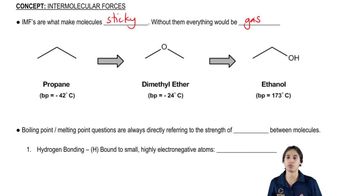
The boiling point of a substance is the temperature at which its vapor pressure equals the external pressure, causing it to change from a liquid to a gas. Factors influencing boiling point include molecular weight, intermolecular forces, and the presence of functional groups. Generally, stronger intermolecular forces lead to higher boiling points.
Recommended video:
Guided course
03:08
How IMFs are related to melting and boiling points.

Intermolecular Forces

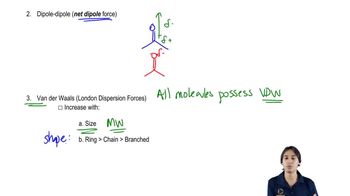
Intermolecular forces are the forces of attraction or repulsion between molecules. They include hydrogen bonding, dipole-dipole interactions, and London dispersion forces. Alcohols, like butyl alcohol, can form hydrogen bonds due to their hydroxyl (-OH) groups, which significantly increases their boiling point compared to ethers, like diethyl ether, which primarily exhibit weaker van der Waals forces.
Recommended video:
Guided course
03:01
How Van der Waals forces work.

Functional Groups

Functional groups are specific groups of atoms within molecules that are responsible for the characteristic chemical reactions of those molecules. In this context, butyl alcohol contains a hydroxyl group (-OH), which is polar and capable of hydrogen bonding, while diethyl ether has an ether functional group (R-O-R), which is less polar and does not engage in hydrogen bonding as effectively, affecting their boiling points.
Recommended video:
Guided course
02:36
Identifying Functional Groups