Ch.8 - Reactions of Alkenes
Wade - Organic Chemistry 9th Edition
Wade9th EditionOrganic ChemistryISBN: 9780135213728Not the one you use?Change textbook
Chapter 8, Problem 56a

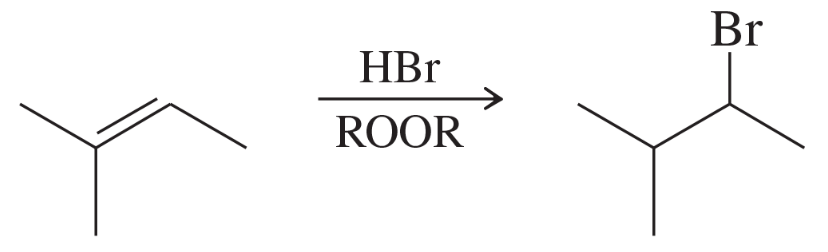
Propose mechanisms consistent with the following reactions.
(a)

Verified step by step guidance
1
Step 1: Recognize that the reaction involves the addition of HBr in the presence of a peroxide (ROOR or H2O2). This is a classic example of anti-Markovnikov addition due to the radical mechanism induced by the peroxide.
Step 2: Initiation: The peroxide (ROOR or H2O2) undergoes homolytic cleavage under heat or light to form two alkoxy radicals. This step generates the reactive species needed to start the radical chain reaction.
Step 3: Propagation: The alkoxy radical reacts with HBr, abstracting a hydrogen atom to form a bromine radical (Br•). The bromine radical then reacts with the alkene, adding to the less substituted carbon of the double bond to form a new carbon-centered radical.
Step 4: The newly formed carbon-centered radical reacts with another molecule of HBr, abstracting a hydrogen atom to form the final product, where bromine is attached to the less substituted carbon of the original double bond.
Step 5: Termination: Any two radicals in the system can combine to form a stable molecule, ending the chain reaction. This step ensures that the reaction does not continue indefinitely.

Verified video answer for a similar problem:

This video solution was recommended by our tutors as helpful for the problem above.
Video duration:
7m
Was this helpful?

Key Concepts

Here are the essential concepts you must grasp in order to answer the question correctly.

Electrophilic Addition Reactions

Electrophilic addition reactions involve the addition of an electrophile to a nucleophile, typically across a double or triple bond. In this case, HBr acts as the electrophile, adding to the alkene. Understanding the mechanism of electrophilic addition is crucial for predicting the products formed in reactions involving alkenes and alkynes.
Recommended video:
Guided course
05:39
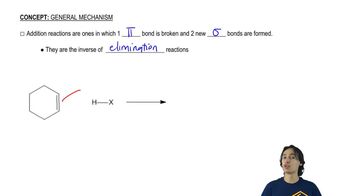
Features of Addition Mechanisms.

Radical Mechanisms

Radical mechanisms involve the formation and reaction of free radicals, which are highly reactive species with unpaired electrons. The presence of ROOR (peroxides) suggests a radical pathway, where the addition of HBr can proceed via a radical mechanism, leading to the formation of brominated products. Recognizing the role of radicals is essential for understanding the reaction pathway.
Recommended video:
Guided course
03:28
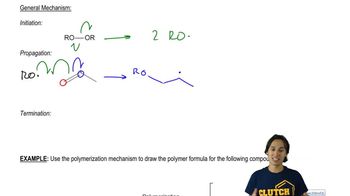
The mechanism of Radical Polymerization.

Markovnikov's Rule

Markovnikov's Rule states that in the addition of HX to an alkene, the hydrogen atom will attach to the carbon with the greater number of hydrogen atoms already attached, while the halide will attach to the carbon with fewer hydrogen atoms. This principle helps predict the regioselectivity of the product formed in the reaction, which is important for proposing accurate mechanisms.
Recommended video:
Guided course
03:54
The 18 and 16 Electron Rule