Within each set of structures, indicate which will react fastest, and which slowest, toward nucleophilic addition in basic conditions. (b)
Verified step by step guidance
1
Step 1: Analyze the chemical structures provided. The four compounds are benzaldehyde derivatives with varying substituents attached to the carbonyl group. These substituents will influence the reactivity toward nucleophilic addition under basic conditions.
Step 2: Recall the concept of electrophilicity. The carbonyl carbon in aldehydes and ketones is electrophilic due to the polarization of the C=O bond. Substituents that increase electron density on the carbonyl carbon decrease its electrophilicity, while substituents that withdraw electron density increase electrophilicity.
Step 3: Compare the substituents attached to the carbonyl group in each structure. The first structure has a methyl group, the second structure has a hydrogen atom (aldehyde), the third structure has an ethyl group, and the fourth structure has a propyl group. Larger alkyl groups donate electron density via hyperconjugation and inductive effects, reducing electrophilicity.
Step 4: Rank the reactivity based on substituent effects. Aldehydes (second structure) are generally more reactive than ketones (first, third, and fourth structures) because the hydrogen atom does not donate electron density. Among the ketones, the one with the smallest alkyl group (first structure) will react faster than those with larger alkyl groups (third and fourth structures).
Step 5: Conclude the ranking. The second structure (aldehyde) will react fastest due to its high electrophilicity, while the fourth structure (ketone with a propyl group) will react slowest due to the electron-donating effects of the larger alkyl group.
Verified video answer for a similar problem:
This video solution was recommended by our tutors as helpful for the problem above
Video duration:
6m
Play a video:
0 Comments
Key Concepts
Here are the essential concepts you must grasp in order to answer the question correctly.
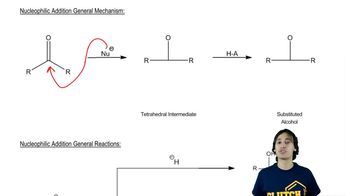
Nucleophilic Addition
Nucleophilic addition is a fundamental reaction in organic chemistry where a nucleophile attacks an electrophilic carbon atom, typically in carbonyl compounds. This reaction is crucial for understanding how different functional groups interact with nucleophiles, influencing the rate of reaction based on steric and electronic factors.
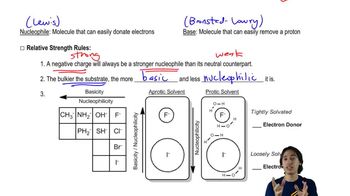
Basic conditions refer to an environment where the pH is greater than 7, often involving the presence of hydroxide ions (OH-). In nucleophilic addition reactions, basic conditions can enhance the nucleophilicity of certain species, affecting the reactivity of the substrates involved, particularly carbonyl compounds.
Understanding the difference between basicity and nucleophilicity.
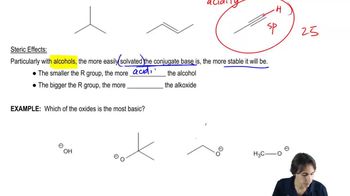
Steric and Electronic Effects
Steric effects relate to the spatial arrangement of atoms in a molecule, which can hinder or facilitate the approach of a nucleophile. Electronic effects involve the distribution of electron density, influencing the electrophilicity of the carbon atom. Both effects are critical in determining the relative rates of nucleophilic addition reactions among different structures.