Ch. 3 - Alkanes and Cycloalkanes: Properties and Conformational Analysis
Mullins - Organic Chemistry: A Learner Centered Approach 1st Edition
Mullins1st EditionOrganic Chemistry: A Learner Centered ApproachISBN: 9780137566471Not the one you use?Change textbook
Chapter 2, Problem 55e

Looking down the indicated bond, show the three most stable conformations and choose the one that is most stable. Be sure that the first Newman projection you show is the one you see initially (before rotation). [Why should none of your three Newman projections show eclipsed conformations?]
(e) <IMAGE>

Verified step by step guidance
1
Step 1: Begin by identifying the bond you are looking down in the molecule. This is typically indicated in the problem or image. Visualize the molecule in 3D space and determine the groups attached to the front and back carbons of the bond.
Step 2: Draw the initial Newman projection based on the given orientation. In a Newman projection, the front carbon is represented as a dot, and the back carbon is represented as a circle. Arrange the substituents around the front and back carbons according to their positions in the molecule.
Step 3: Rotate the bond in increments of 60° to generate the three staggered conformations. Staggered conformations occur when the substituents on the front and back carbons are spaced as far apart as possible, minimizing torsional strain. Avoid eclipsed conformations, as they result in higher energy due to steric and torsional strain.
Step 4: Evaluate the stability of each staggered conformation by considering factors such as steric hindrance (size of substituents) and electronic effects (e.g., dipole interactions). The most stable conformation will typically have the largest groups positioned anti to each other (180° apart).
Step 5: Choose the most stable conformation based on your evaluation. This conformation minimizes steric and torsional strain, making it the lowest-energy arrangement. Ensure that none of the Newman projections you draw show eclipsed conformations, as these are energetically unfavorable.

Verified video answer for a similar problem:

This video solution was recommended by our tutors as helpful for the problem above.
Video duration:
9m
Was this helpful?

Key Concepts

Here are the essential concepts you must grasp in order to answer the question correctly.

Newman Projections

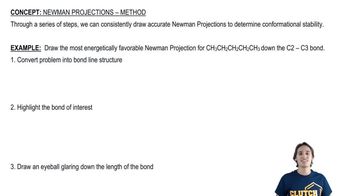
Newman projections are a way to visualize the conformation of a molecule by looking straight down a bond connecting two carbon atoms. This representation helps in analyzing the spatial arrangement of substituents around the bond, allowing for the identification of different conformations, such as staggered and eclipsed forms.
Recommended video:
Guided course
00:34
Introduction to Drawing Newman Projections

Staggered vs. Eclipsed Conformations

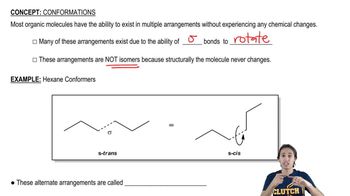
In organic chemistry, staggered conformations occur when substituents on adjacent carbons are positioned as far apart as possible, minimizing steric strain. In contrast, eclipsed conformations have substituents aligned with each other, leading to increased steric hindrance and torsional strain, making them less stable than staggered conformations.
Recommended video:
Guided course
03:29
Understanding what a conformer is.

Conformational Stability

Conformational stability refers to the relative energy levels of different molecular conformations. Generally, staggered conformations are more stable due to lower energy states compared to eclipsed conformations, which are higher in energy due to increased steric interactions. Understanding this concept is crucial for predicting the most stable conformation in a given molecular structure.
Recommended video:
Guided course
03:29
Understanding what a conformer is.
Related Practice
Textbook Question

For each chair on the left, place the substituents on the flipped chair. [Recall that the axial/equatorial designation changes from one chair to the next, but the carbon to which the substituent is attached does not.]

(c)

646
views

Textbook Question

Using the numbers shown in the chair conformation on the left, label the carbons of the flipped chair on the right. [Assume that the angle through which you view the chair conformation doesn't change.] 

1451
views
Textbook Question

For each pair of conformations shown, choose which is most stable. [If both conformations have the same number of gauche interactions, choose the one where the interactions are between smaller groups.]

(f)

1179
views
Textbook Question

For each chair on the left, place the substituents on the flipped chair. [Recall that the axial/equatorial designation changes from one chair to the next, but the carbon to which the substituent is attached does not.]

(e)

741
views
Textbook Question

For each pair of conformations shown, choose which is most stable. [If both conformations have the same number of gauche interactions, choose the one where the interactions are between smaller groups.]

(e)

785
views
Textbook Question

Looking down the indicated bond, show the three most stable conformations and choose the one that is most stable. Be sure that the first Newman projection you show is the one you see initially (before rotation). [Why should none of your three Newman projections show eclipsed conformations?]

(b) <IMAGE>

1143
views