
Ch. 9 - Substitution and Elimination Reactions of Alkyl Halides
Bruice - Organic Chemistry 8th Edition
Bruice8th EditionOrganic ChemistryISBN: 9780135213711Not the one you use?Change textbook
Chapter 10, Problem 4

Does increasing the energy barrier for an SN2 reaction increase or decrease the magnitude of the rate constant for the reaction?

Verified step by step guidance
1
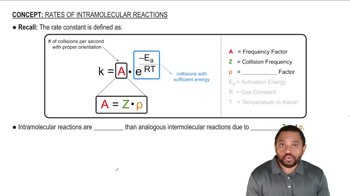
Understand the relationship between the energy barrier and the rate constant: The rate constant (k) for a reaction is related to the activation energy (Ea) through the Arrhenius equation: k=AeEaRT, where A is the pre-exponential factor, R is the gas constant, and T is the temperature.
Recognize that the energy barrier corresponds to the activation energy (Ea): In an SN2 reaction, the energy barrier is the energy required to reach the transition state from the reactants. A higher energy barrier means a larger Ea.
Analyze the effect of increasing Ea on the rate constant: From the Arrhenius equation, as Ea increases, the exponential term eEaRT decreases, which in turn decreases the value of k.
Conclude the relationship: Increasing the energy barrier (Ea) decreases the magnitude of the rate constant (k) for the SN2 reaction because the reaction becomes slower as it requires more energy to overcome the activation energy.
Relate this to reaction conditions: To counteract the effect of a higher energy barrier, one could increase the temperature (T) in the Arrhenius equation, as a higher temperature would increase the rate constant despite a higher Ea.

Verified video answer for a similar problem:

This video solution was recommended by our tutors as helpful for the problem above.
Video duration:
4m
Was this helpful?

Key Concepts

Here are the essential concepts you must grasp in order to answer the question correctly.

SN2 Reaction Mechanism

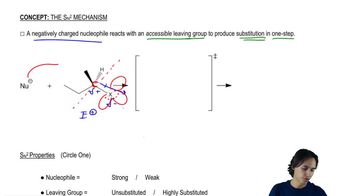
The SN2 (substitution nucleophilic bimolecular) reaction is a type of nucleophilic substitution where a nucleophile attacks an electrophile, resulting in the simultaneous displacement of a leaving group. This reaction occurs in a single concerted step, meaning that bond formation and bond breaking happen simultaneously. The rate of an SN2 reaction depends on the concentration of both the nucleophile and the substrate, making it a second-order reaction.
Recommended video:
Guided course
08:33
Drawing the SN2 Mechanism

Activation Energy and Rate Constant

Activation energy is the minimum energy required for a reaction to occur. According to the Arrhenius equation, the rate constant (k) of a reaction is inversely related to the activation energy; as the energy barrier increases, the rate constant decreases. This relationship highlights how higher activation energy makes it less likely for reactants to successfully collide with enough energy to form products, thus slowing the reaction.
Recommended video:
2:29
Rates of Intramolecular Reactions Concept 1

Effect of Energy Barrier on Reaction Rate

The energy barrier of a reaction directly influences its rate. In the context of an SN2 reaction, increasing the energy barrier means that fewer molecules will have sufficient energy to overcome this barrier, leading to a decrease in the rate of reaction. Consequently, as the energy barrier rises, the magnitude of the rate constant decreases, indicating a slower reaction rate.
Recommended video:
2:29
Rates of Intramolecular Reactions Concept 1