Ch. 1 - Angles and the Trigonometric Functions
Blitzer - Trigonometry 3rd Edition
Blitzer3rd EditionTrigonometryISBN: 9780137316601Not the one you use?Change textbook
Chapter 1, Problem 8

In Exercises 8–12, draw each angle in standard position. 5πœ‹ 6

Verified step by step guidance
1
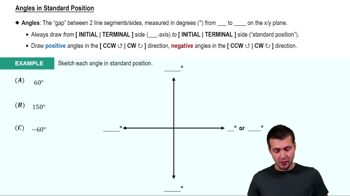
Understand that an angle in standard position is drawn with its vertex at the origin of the coordinate plane, its initial side along the positive x-axis, and the angle measured counterclockwise for positive angles.
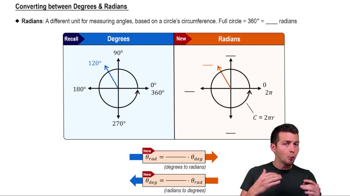
Identify the given angle: \(\frac{5\pi}{6}\). This is a radian measure, so recall that \(\pi\) radians equals 180 degrees.
Convert the angle to degrees if it helps visualization: multiply by \(\frac{180}{\pi}\) to get \(\frac{5\pi}{6} \times \frac{180}{\pi} = 150^\circ\).
Draw the initial side along the positive x-axis. From there, measure an angle of 150 degrees counterclockwise to locate the terminal side of the angle.
Mark the terminal side of the angle in the second quadrant, since 150 degrees is between 90 and 180 degrees, and label the angle as \(\frac{5\pi}{6}\) radians.

Verified video answer for a similar problem:

This video solution was recommended by our tutors as helpful for the problem above.
Video duration:
3m
Was this helpful?

Key Concepts

Here are the essential concepts you must grasp in order to answer the question correctly.

Standard Position of an Angle

An angle is in standard position when its vertex is at the origin of the coordinate plane, its initial side lies along the positive x-axis, and the angle is measured by rotating the initial side to the terminal side. Understanding this helps in accurately drawing and interpreting angles.
Recommended video:
05:50
Drawing Angles in Standard Position

Radian Measure

Radian measure expresses angles based on the radius of a circle, where 2Ο€ radians equal 360 degrees. Knowing how to convert and interpret radians, such as 5Ο€/6, is essential for drawing angles and solving trigonometric problems.
Recommended video:
5:04
Converting between Degrees & Radians

Unit Circle and Reference Angles

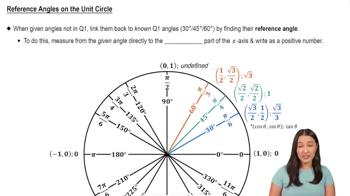
The unit circle is a circle with radius 1 centered at the origin, used to define trigonometric functions. Reference angles help determine the position of an angle's terminal side by relating it to a known acute angle, facilitating accurate drawing and analysis.
Recommended video:
5:31
Reference Angles on the Unit Circle
Related Practice
Textbook Question

In Exercises 7–12, find the radian measure of the central angle of a circle of radius r that intercepts an arc of length s. Radius, r: 10 inches Arc Length, s: 40 inches

1042
views
Textbook Question

In Exercises 5–7, convert each angle in radians to degrees. - 5πœ‹ 6

557
views
Textbook Question

The unit circle has been divided into twelve equal arcs, corresponding to t-values of


0, πœ‹/6, πœ‹/3, πœ‹/2, 2πœ‹/3, 5πœ‹/6, πœ‹, 7πœ‹/6, 4πœ‹/3, 3πœ‹/2, 5πœ‹/3, 11πœ‹/6, and 2πœ‹


Use the (x,y) coordinates in the figure to find the value of each trigonometric function at the indicated real number, t, or state that the expression is undefined.

<IMAGE>


cos 5πœ‹/6

506
views
Textbook Question

In Exercises 5–18, the unit circle has been divided into twelve equal arcs, corresponding to t-values of 0, πœ‹, πœ‹, πœ‹, 2πœ‹, 5πœ‹, πœ‹, 7πœ‹, 4πœ‹, 3πœ‹, 5πœ‹, 11πœ‹, and 2πœ‹. 6 3 2 3 6 6 3 2 3 6 Use the (x,y) coordinates in the figure to find the value of each trigonometric function at the indicated real number, t, or state that the expression is undefined.

cos 2πœ‹/3

3308
views
1
rank
Textbook Question

In Exercises 8–13, find the exact value of each expression. Do not use a calculator. tan 300Β°

704
views
Textbook Question

In Exercises 1–8, a point on the terminal side of angle ΞΈ is given. Find the exact value of each of the six trigonometric functions of ΞΈ. (-1, -3)

583
views