Ch. 1 - Trigonometric Functions
Lial - Trigonometry 12th Edition
Lial12th EditionTrigonometryISBN: 9780136552161Not the one you use?Change textbook
Chapter 2, Problem 100

If n is an integer, n • 180° represents an integer multiple of 180°, (2n + 1) • 90° represents an odd integer multiple of 90° , and so on. Determine whether each expression is equal to 0, 1, or ―1, or is undefined. sin[n • 180°]

Verified step by step guidance
1
Recall the general behavior of the sine function: \(\sin(\theta)\) equals 0 whenever \(\theta\) is an integer multiple of \(180^\circ\), i.e., \(\theta = k \times 180^\circ\) for any integer \(k\).
Given the expression \(\sin[n \cdot 180^\circ]\), recognize that \(n\) is an integer, so the angle is exactly an integer multiple of \(180^\circ\).
Use the property of sine at these angles: \(\sin(k \times 180^\circ) = 0\) for all integers \(k\).
Therefore, \(\sin[n \cdot 180^\circ]\) must be equal to 0 for any integer \(n\).
No undefined values or other outputs (like 1 or -1) occur for this expression because sine is defined for all real numbers and specifically zero at these multiples.

Verified video answer for a similar problem:

This video solution was recommended by our tutors as helpful for the problem above.
Video duration:
3m
Was this helpful?

Key Concepts

Here are the essential concepts you must grasp in order to answer the question correctly.

Sine Function and Its Periodicity

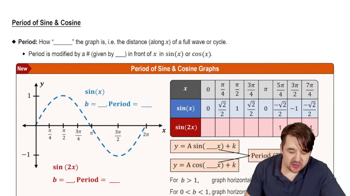
The sine function is periodic with a period of 360°, meaning sin(θ) = sin(θ + 360°k) for any integer k. This periodicity helps simplify angles by reducing them modulo 360°, making it easier to evaluate sine values for large or multiple-angle expressions.
Recommended video:
5:33
Period of Sine and Cosine Functions

Sine of Integer Multiples of 180°

For any integer n, sin(n • 180°) equals zero because 180° corresponds to π radians, where the sine function crosses the x-axis. Thus, sin(n • 180°) = 0 for all integers n, reflecting the zeros of the sine wave at these points.
Recommended video:
4:27
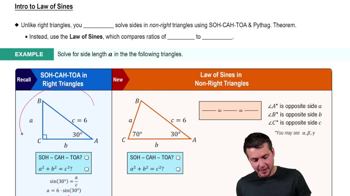
Intro to Law of Sines

Angle Representation in Degrees and Radians

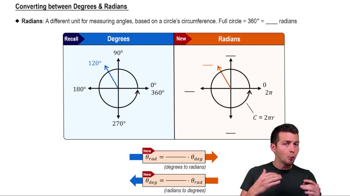
Angles can be expressed in degrees or radians, with 180° equal to π radians. Understanding this conversion is essential for interpreting trigonometric expressions and applying known sine values at key angles, such as multiples of 90° or 180°.
Recommended video:
5:04
Converting between Degrees & Radians