Determine the signs of the trigonometric functions of an angle in standard position with the given measure. See Example 2. 84°
Ch. 1 - Trigonometric Functions
Chapter 2, Problem 29
Find the values of the six trigonometric functions for an angle in standard position having each given point on its terminal side. Rationalize denominators when applicable. (―8 , 15)
Verified step by step guidance1
Identify the coordinates of the point on the terminal side of the angle: \(x = -8\) and \(y = 15\).
Calculate the radius (or hypotenuse) \(r\) using the distance formula: \(r = \sqrt{x^2 + y^2} = \sqrt{(-8)^2 + 15^2}\).
Use the definitions of the six trigonometric functions in terms of \(x\), \(y\), and \(r\):
- \(\sin \theta = \frac{y}{r}\)
- \(\cos \theta = \frac{x}{r}\)
- \(\tan \theta = \frac{y}{x}\)
- \(\csc \theta = \frac{r}{y}\)
- \(\sec \theta = \frac{r}{x}\)
- \(\cot \theta = \frac{x}{y}\).
Substitute the values of \(x\), \(y\), and \(r\) into each function to express them in simplest form, and rationalize denominators where necessary.
Determine the signs of each function based on the quadrant where the point \((-8, 15)\) lies (Quadrant II) to finalize the values of the trigonometric functions.

Verified video answer for a similar problem:
This video solution was recommended by our tutors as helpful for the problem above.
Video duration:
5mWas this helpful?
Key Concepts
Here are the essential concepts you must grasp in order to answer the question correctly.
Coordinates and the Terminal Side of an Angle
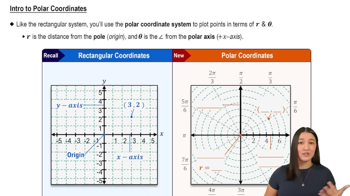
An angle in standard position has its vertex at the origin and its initial side along the positive x-axis. The terminal side passes through a given point (x, y), which helps determine the angle's trigonometric values by relating x and y to the radius (distance from origin).
Recommended video:
Intro to Polar Coordinates
Definition of the Six Trigonometric Functions Using Coordinates
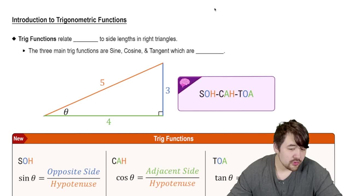
The six trigonometric functions—sine, cosine, tangent, cosecant, secant, and cotangent—can be defined using the coordinates (x, y) of a point on the terminal side and the radius r = √(x² + y²). For example, sin θ = y/r and cos θ = x/r, linking geometry to function values.
Recommended video:
Introduction to Trigonometric Functions
Rationalizing Denominators
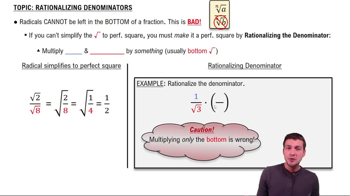
Rationalizing denominators involves eliminating any square roots or irrational numbers from the denominator of a fraction. This is done by multiplying numerator and denominator by a suitable radical, ensuring the final trigonometric values are expressed in a simplified, standard form.
Recommended video:
Rationalizing Denominators
Related Practice
Textbook Question
751
views
Textbook Question
The measures of two angles of a triangle are given. Find the measure of the third angle. See Example 2.
29.6° , 49.7°
774
views
Textbook Question
Find the measure of each marked angle. See Example 2 supplementary angles with measures 6𝓍 - 4 and 8𝓍 - 12 degrees
608
views
Textbook Question
Sketch an angle θ in standard position such that θ has the least positive measure, and the given point is on the terminal side of θ. Then find the values of the six trigonometric functions for each angle. Rationalize denominators when applicable. See Examples 1, 2, and 4. (―2√3 , 2)
606
views
Textbook Question
Find the measure of each marked angle. See Example 2 supplementary angles with measures 10𝓍 + 7 and 7𝓍 + 3 degrees
649
views
Textbook Question
Find the measure of each marked angle. See Example 2.
525
views