Find exact values of the six trigonometric functions of each angle. Rationalize denominators when applicable. See Examples 2, 3, and 5. 1305°
Ch. 2 - Acute Angles and Right Triangles
Chapter 3, Problem 24
Find exact values of the six trigonometric functions of each angle. Rationalize denominators when applicable. See Examples 2, 3, and 5. 495°
Verified step by step guidance1
Step 1: Recognize that the angle given, 495°, is greater than 360°, so first find its reference angle by subtracting multiples of 360° to bring it within the standard 0° to 360° range. Calculate: \(495° - 360° = 135°\).
Step 2: Identify the quadrant in which the angle 135° lies. Since 135° is between 90° and 180°, it lies in the second quadrant.
Step 3: Determine the reference angle for 135°, which is the acute angle it makes with the x-axis. Calculate: \(180° - 135° = 45°\).
Step 4: Use the known exact trigonometric values for 45° to find the sine, cosine, and tangent of 135°, considering the signs of these functions in the second quadrant (sine positive, cosine negative, tangent negative). For example, \(\sin 135° = \sin 45°\), \(\cos 135° = -\cos 45°\), and \(\tan 135° = -\tan 45°\).
Step 5: Calculate the reciprocal functions (cosecant, secant, and cotangent) by taking the reciprocals of sine, cosine, and tangent respectively, and rationalize denominators if necessary.

Verified video answer for a similar problem:
This video solution was recommended by our tutors as helpful for the problem above.
Video duration:
8mWas this helpful?
Key Concepts
Here are the essential concepts you must grasp in order to answer the question correctly.
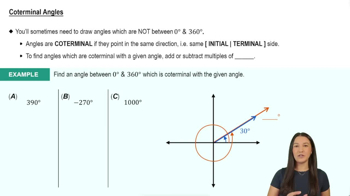
Reference Angles and Coterminal Angles
To find trigonometric values for angles greater than 360°, first determine the coterminal angle by subtracting 360° until the angle lies between 0° and 360°. Then, find the reference angle, which is the acute angle formed with the x-axis, to use known trigonometric values.
Recommended video:
Coterminal Angles
Signs of Trigonometric Functions in Different Quadrants
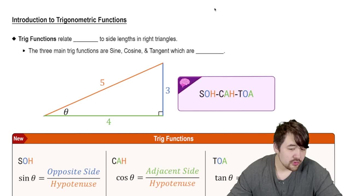
The sign of sine, cosine, and tangent depends on the quadrant where the angle's terminal side lies. For example, sine is positive in quadrants I and II, cosine in I and IV, and tangent in I and III. This helps assign the correct sign to the function values.
Recommended video:
Introduction to Trigonometric Functions
Rationalizing Denominators
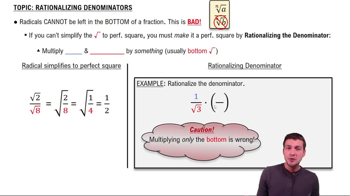
When trigonometric values involve radicals in the denominator, rationalizing means rewriting the expression to eliminate radicals from the denominator. This is done by multiplying numerator and denominator by a suitable radical, resulting in a simplified and standardized form.
Recommended video:
Rationalizing Denominators
Related Practice
Textbook Question
714
views
Textbook Question
Evaluate each expression. Give exact values. tan² 120° - 2 cot 240°
570
views
Textbook Question
Write each function in terms of its cofunction. Assume all angles involved are acute angles. See Example 2. sin 45°
680
views
Textbook Question
Evaluate each expression. Give exact values. sec² 300° - 2 cos² 150°
656
views
Textbook Question
Solve each right triangle. In each case, C = 90°. If angle information is given in degrees and minutes, give answers in the same way. If angle information is given in decimal degrees, do likewise in answers. When two sides are given, give angles in degrees and minutes. See Examples 1 and 2. B = 73.0°, b = 128 in.
621
views
Textbook Question
Write each function in terms of its cofunction. Assume all angles involved are acute angles. See Example 2. tan 25.4°
681
views