Ch. 2 - Acute Angles and Right Triangles
Lial - Trigonometry 12th Edition
Lial12th EditionTrigonometryISBN: 9780136552161Not the one you use?Change textbook
Chapter 3, Problem 45

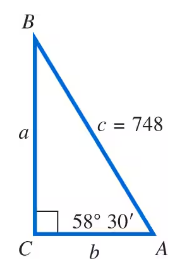
Solve each right triangle. In Exercise 46, give angles to the nearest minute. In Exercises 47 and 48, label the triangle ABC as in Exercises 45 and 46.

Verified step by step guidance
1
Identify the given information in the right triangle, such as the lengths of sides or measures of angles. Typically, you will have one right angle (90°) and either one other angle or some side lengths provided.
Use the Pythagorean theorem to find the missing side if two sides are known. The theorem states: \(a^2 + b^2 = c^2\), where \(c\) is the hypotenuse and \(a\), \(b\) are the legs of the triangle.
Apply trigonometric ratios (sine, cosine, tangent) to find the unknown angles or sides. For example, if you know an angle \(\theta\) and a side, use \(\sin(\theta) = \frac{\text{opposite}}{\text{hypotenuse}}\), \(\cos(\theta) = \frac{\text{adjacent}}{\text{hypotenuse}}\), or \(\tan(\theta) = \frac{\text{opposite}}{\text{adjacent}}\).
To find an angle to the nearest minute, first calculate the angle in decimal degrees using inverse trigonometric functions (e.g., \(\sin^{-1}\), \(\cos^{-1}\), \(\tan^{-1}\)), then convert the decimal part of the degree to minutes by multiplying by 60.
Label the triangle as \(\triangle ABC\) according to the problem instructions, ensuring that angle \(C\) is the right angle if specified, and assign sides opposite to each angle accordingly. This helps keep track of which sides correspond to which angles when applying trigonometric ratios.

Verified video answer for a similar problem:

This video solution was recommended by our tutors as helpful for the problem above.
Video duration:
5m
Was this helpful?

Key Concepts

Here are the essential concepts you must grasp in order to answer the question correctly.

Right Triangle Properties

A right triangle has one angle of 90 degrees, and the other two angles are acute and complementary. Understanding the relationships between the sides and angles, such as the hypotenuse being the longest side, is essential for solving the triangle.
Recommended video:
5:35
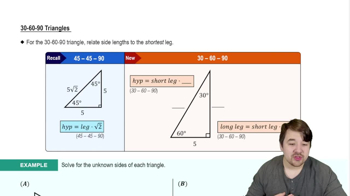
30-60-90 Triangles

Trigonometric Ratios (Sine, Cosine, Tangent)

Trigonometric ratios relate the angles of a right triangle to the ratios of its sides. Sine, cosine, and tangent functions help find unknown sides or angles when given partial information, using definitions like sin(θ) = opposite/hypotenuse.
Recommended video:
5:08
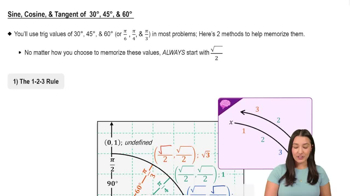
Sine, Cosine, & Tangent of 30°, 45°, & 60°

Angle Measurement and Conversion to Minutes

Angles can be expressed in degrees, minutes, and seconds, where one degree equals 60 minutes. Converting decimal degrees to degrees and minutes is important for precise angle measurement, especially when the problem requires rounding to the nearest minute.
Recommended video:
5:31
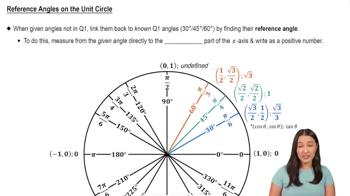
Reference Angles on the Unit Circle